Recovery Vans

  • Subscribe to our RSS feed.
  • Twitter
  • StumbleUpon
  • Reddit
  • Facebook
  • Digg

Saturday, 29 June 2013

History of Art Crime: ARCA Student A. M. C. Knutsson Writes on Book Thief Anders Burius and the Theft at the Swedish Royal Library

Posted on 11:40 by Unknown
by A. M. C. Knutsson, ARCA Student 2013
 
Photo: Andrea Davis Kronlund and Jens Östman
http://www.wytflietatlas.com 
At 04.30 am on the 8th of December 2004, a top floor apartment in Central Stockholm explodes, injuring 11 people and forcing the evacuation of 44 others. Four days later the body of a man was found among the debris, along with a pro and con list of whether or not to stay alive. The man’s wrists had been slashed and the gas lead had been cut repeatedly; it remains uncertain whether Anders Burius was alive when his apartment exploded. Three days earlier Burius had been released from custody. 

Anders Burius had been the chief of the Swedish Royal Library’s Manuscript Department, and in charged of imposing increased safety measures following the thefts by renowned map-thief Peter Bellwood. Burius had also been stealing books from various libraries since 1986.

During the spring of 2004, the Royal Library personnel were looking for an 1850 map of the Mississippi. The online database REGINA still contained an entry indicating that the book would be in the library's possession, however it could not be located within the library. Following an inventory of the book stacks, it was revealed that more than 50 books had gone missing.  As the investigation wore on, Burius felt that it was only a matter of time before he would be exposed and he confessed to a colleague.

On the All Saints Eve, Burius sent a text message to a colleague, “Now I’m going into Bergsgatan 58 [the police station]”. At 4.40 pm, Burius was arrested for the thefts in the Royal Library. He was almost immediately dubbed "KB mannen" (the Royal Library man) by the media and his story spread through the news like wildfire. During his three weeks in custody, he kept writing lists for the police of all the books he had stolen. In total, Burius appears to have stolen 103 books whereof 58 where from the Royal Library. As the investigation dragged out, Burius was temporarily released.

At the time of the discovery of the thefts, Burius had systematically retrieved books from his work for a decade. He had, with his intimate knowledge of the library, been able to steal books and remove entries from the old card index in order to conceal his crimes.  However, over time, Burius had become less careful and started leaving catalogue traces behind. In addition to his meddling with the catalogues, Burius was also careful to remove identifying marks from the books. In the extreme case of Maximilianus Transylvanus' 1523 account of Magellan’s tour of the world, he had even cut the text-block out of its original binding and had it rebound in Germany in order to conceal its connection to the Royal Library. The book was later sold for €94,300.

After ‘cleaning’ the books, Burius approached dealers in Germany under the pseudonym Karl Fields, a nod to the Swedish poet Karlfeldt. The auction house Ketterer Kunst, Burius claimed, only required the seller to sign an assurance of ownership and made no effort to check the provenance of the works offered for sale. Ketterer Kunst maintains that they did nothing wrong in selling the books as Burius had confirmed that the books were his.

In June 2012, one of the most important stolen objects resurfaced in New York. The Cornelius Wytfliet atlas that contains one of the earliest maps of North America was offered for sale by W. Graham ArderIII. He in turn had purchased it in good faith from Sotheby’s in 2003 for $100,000; its current value was estimated at $450,000. Mr Arder returned the book to Sotheby’s who reimbursed him in full and later returned it to the Royal Library after negotiations. Whilst it is hoped that this find will encourage other books to resurface, most of these books have now been legally acquired by ‘good faith’ purchasers and it is uncertain whether the Royal Library will be able to recreate its marred collections.

Bibliography

http://www.herrick.com/siteFiles/News/B6C44B1FDFDEFECAFB7BCB94496A843D.pdf

Cohen, Patricia, http://www.nytimes.com/2012/06/27/books/swedish-royal-library-recovers-stolen-1597-atlas-in-new-york.html?_r=0,  27/06/12
Repo, Walter,  http://cafe.se/dokument-sanningen-om-kb-mannen/, 19/01/11
Taubert, Johan , http://www.svd.se/nyheter/inrikes/kraftig-explosion-i-stockholm_180474.svd , 8/12/04

Radio:
http://sverigesradio.se/sida/artikel.aspx?programid=909&artikel=2462939

Tv-dramatisation:

Bibliotekstjuven (The Library Thief), originally aired January 2011
Read More
Posted in A.M.C. Knutsson, Anders Burius, ARCA 2013, Insider theft, Swedish Royal Library | No comments

Friday, 28 June 2013

ARCA Alum Marc Balcells Speaks with artroop.com about the beauty of theories and art crime

Posted on 20:36 by Unknown
Here's a link to an interview published June 27th with criminologist Marc Balcells (ARCA Alum '11) on the blog, artroop.com. It's in Spanish but there's an option to click on Google Translate for those who need assistance in comprehending the text. Mr. Balcells is a Fulbright scholar, Spanish criminologist, and a criminal lawyer. He currently lives in New York where he is completing a PhD in Criminal Justice.

In this post on artroop.com, Mr. Balcells discusses the beauty of theory and his approach as a criminologist is in examining the motives of art thieves which may lead to prevention of art crimes.

Mr. Balcells is also co-editor of The Journal of Art Crime, a publication of ARCA.
Read More
Posted in art theft, criminology, Marc Balcells | No comments

Sunday, 23 June 2013

Il Tempo publishes piece on ARCA's Fifth International Art Crime Conference

Posted on 00:00 by Unknown
Here's a link to an article by Giuseppe Grifeo in the Italian publication Il Tempo on ARCA's fifth international art crime conference held in the ancient Umbrian town of Amelia.

Here's a link to Google translating that same piece which essentially describes some of Amelia's historical and cultural significance: the medieval village likely emerged as early as the 9th century BC and is today surrounded by 4th century BC polygonal limestone bolders. Amelia was ruled by Romans, sacked by Goths, asserted its freedom from the papacy in the Middle Ages, and was the birthplace of the great painter Piermatteo d'Amelia and Alessandro Geraldini, a papal representative to the Spanish Court of King Ferdinand and Queen Isabella and the editor of a volume that first described the New World, Itinerarium ad regiones sub aequinoctiali plaga constitutas.

ARCA's International Art Crime Conference, organized by CEO Lynda Albertson and founder Noah Charney, was attended by officiers of law enforcement agencies around the world (at least from the countries of Canada, China (Hong Kong), and The Netherlands) fighting against crimes against art and the looting of antiquities and criminologist and academics and students from universities around the world.

The article notes that Prince Sisowath Ravivaddhana Monipong of the ruling family in Cambodia presented an award to Sharon Cohen Levin, Head of Asset Forfeiture for the US Attorney's office in the Southern District of New York for the recovery of a sandstone statue of a 10th century statue stolen from the temple Prasat Chen, an archaeological site of Koh Ker.
Read More
Posted in 2013 ARCA Annual Art And Heritage Conference, Lynda Albertson, Noah Charney, Sharon Cohen Levin | No comments

Thursday, 20 June 2013

Week 3 from Amelia: ARCA Intern Yasmin Hamed on Dr. Noah Charney's Course on Art Crime, Forgeries, Umbrian olive oil, and visiting nearby towns

Posted on 00:00 by Unknown
Spoleto
by Yasmin Hamed, ARCA Intern


After a week of getting to grips with classes and living like Amerini, students in ARCA's Postgraduate Certificate Program in Art Crime and Cultural Heritage Protection hit the ground running this week both in and out of the classroom. Monday’s cold weather was met with a warm welcome from Dr. Noah Charney, founder of ARCA, in ‘Art Crime and its History’.

Following an introduction to art history, we were instructed on how to read the symbols of art and question everything concerning the provenance of an artwork. Day Two of our introduction to the history of art crime was aptly titled ‘Art forgery: The World Wants to be Deceived’. Pouring over centuries of case studies related to all that is fake and forged in the art world, we were introduced to some of the most infamous names in the history of art forgery; John Myatt and John Drewe; Han Van Meegeren; and Shaun Greenhaulgh. In keeping with the theme of connoisseurship deeply explored in the past two weeks, we examined fakes within the world of wine.

On Wednesday, Dr. Charney asked the student body to reverse its role and contemplate our own art forgery. After going around the room it was clear to see that not only did our class dive at the chance to plan their own art crime, but for some more than others a career as a master thief may work as a possible Plan B! On a more serious note, this discussion revealed the alarming ease of forging and smuggling art and antiquities. Carrying on from last week, the astounding interconnectivity of each and everyone’s own expertise definitely shone a light on the multifaceted nature of the world of art crime. For example, Mark Collins, a current investigator with the Ontario police, was well equipped to create a suspect profile of criminals in the art world.

After a long day of planning illegal activities, the class descended on the local oil mill for an extremely tasty evening. Along with Monica Di Stefano, the class was introduced to the family of Francesco Suatoni, our local amerino oil producer. Having learned all about the history and production process of olive oil and getting a first-hand view of the presses themselves, the class was treated to a tasting of the local Umbrian olives.

The week progressed with a broadening of our definitions of art crime. Examining the theft of books and literature, bibliographer Anna Knutson was once again able to offer her insights to the class on this niche area of criminal activity.

The end of class Thursday held an exam on all aspects of the history of art crime, famous case studies and definition, after which a much needed celebration was in order! The class ascended the hills of Amelia to the apartment of this year’s writer-in-residence Susan Douglas, a lecturer and writer based in Toronto. Some good wine, great food and even better discussions were had, no doubt leaving a few of us more tired than usual for our last day of Dr. Charney’s lectures. Our final afternoon with ARCA’s founder saw us segue from the world of art crime to obtaining some insider knowledge on the world of publishing. Unsurprisingly, a large number of students seemed intent on publishing in some area whether it be through fiction, academic books or journal articles, all of which were covered in detail with numerous insider tips during Dr. Charney’s session.

On Friday night we said an official goodbye to Cristina Tardaguila, a student visiting the programme for just one week. Tardaguila who currently works as a journalist in Brazil, was a welcome addition throughout the week with many insights into the interaction of the media and art crime, most notably with regard to the severity of antiquities smuggling in South America.

The second ARCA weekend trip of the summer beyond the walls of Amelia led us to Assisi and Spoleto, two similar hilltop Umbrian cities with what can only be described as having spectacular panoramic views. Led by our guides Pierluca Neri and Alessandro Manciucca, both Umbrian natives with a true love of the region, we first explored the Church of St. Francis of Assisi among others whilst including a short wander around the cobbled streets of the town’s many craft shops. Spoleto, although similar, had its own unique sights including a trip to an astounding 13th century aqueduct pouring over the valleys surrounding the town.

Yasmin Hamed has a B.A. Double Honours in Ancient History and Archaeology with French. Last year, Ms. Hamed completed her masters in Classical Archaeology at Trinity College in Dublin.

Here's a link to other posts by the ARCA Interns: orientation and the first week of classes with Dr. Tom Flynn. You may find out more about ARCA's education program here on the website.
Read More
Posted in art crime lecture, art forgery, Noah Charney | No comments

Wednesday, 19 June 2013

Report from Amelia: ARCA Intern Yasmin Hamed

Posted on 06:39 by Unknown
Spoleto
by Yasmin Hamed, ARCA Intern

After a week of getting to grips with classes and living like Amerini, students in ARCA's Postgraduate Certificate Program in Art Crime and Cultural Heritage Protection hit the ground running this week both in and out of the classroom. Monday’s cold weather was met with a warm welcome from Dr. Noah Charney, founder of ARCA, in ‘Art Crime and its History’.

Following an introduction to art history, we were instructed on how to read the symbols of art and question everything concerning the provenance of an artwork. Day Two of our introduction to the history of art crime was aptly titled ‘Art forgery: The World Wants to be Deceived’. Pouring over centuries of case studies related to all that is fake and forged in the art world, we were introduced to some of the most infamous names in the history of art forgery; John Myatt and John Drewe; Han Van Meegeren; and Shaun Greenhaulgh. In keeping with the theme of connoisseurship deeply explored in the past two weeks, we examined fakes within the world of wine.

On Wednesday, Dr. Charney asked the student body to reverse its role and contemplate our own art forgery. After going around the room it was clear to see that not only did our class dive at the chance to plan their own art crime, but for some more than others a career as a master thief may work as a possible Plan B! On a more serious note, this discussion revealed the alarming ease of forging and smuggling art and antiquities. Carrying on from last week, the astounding interconnectivity of each and everyone’s own expertise definitely shone a light on the multifaceted nature of the world of art crime. For example, Mark Collins, a current investigator with the Ontario police, was well equipped to create a suspect profile of criminals in the art world.

After a long day of planning illegal activities, the class descended on the local oil mill for an extremely tasty evening. Along with Monica Di Stefano, the class was introduced to the family of Francesco Suatoni, our local amerino oil producer. Having learned all about the history and production process of olive oil and getting a first-hand view of the presses themselves, the class was treated to a tasting of the local Umbrian olives.

The week progressed with a broadening of our definitions of art crime. Examining the theft of books and literature, bibliographer Anna Knutson was once again able to offer her insights to the class on this niche area of criminal activity.

The end of class Thursday held an exam on all aspects of the history of art crime, famous case studies and definition, after which a much needed celebration was in order! The class ascended the hills of Amelia to the apartment of this year’s writer-in-residence Susan Douglas, a lecturer and writer based in Toronto. Some good wine, great food and even better discussions were had, no doubt leaving a few of us more tired than usual for our last day of Dr. Charney’s lectures. Our final afternoon with ARCA’s founder saw us segue from the world of art crime to obtaining some insider knowledge on the world of publishing. Unsurprisingly, a large number of students seemed intent on publishing in some area whether it be through fiction, academic books or journal articles, all of which were covered in detail with numerous insider tips during Dr. Charney’s session.

On Friday night we said an official goodbye to Cristina Tardaguila, a student visiting the programme for just one week. Tardaguila who currently works as a journalist in Brazil, was a welcome addition throughout the week with many insights into the interaction of the media and art crime, most notably with regard to the severity of antiquities smuggling in South America.

The second ARCA weekend trip of the summer beyond the walls of Amelia led us to Assisi and Spoleto, two similar hilltop Umbrian cities with what can only be described as having spectacular panoramic views. Led by our guides Pierluca Neri and Alessandro Manciucca, both Umbrian natives with a true love of the region, we first explored the Church of St. Francis of Assisi among others whilst including a short wander around the cobbled streets of the town’s many craft shops. Spoleto, although similar, had its own unique sights including a trip to an astounding 13th century aqueduct pouring over the valleys surrounding the town.

Yasmin Hamed has a B.A. Double Honours in Ancient History and Archaeology with French. Last year, Ms. Hamed completed her masters in Classical Archaeology at Trinity College in Dublin.

Here's a link to other posts by the ARCA Interns: orientation and the first week of classes with Dr. Tom Flynn. You may find out more about ARCA's education program here on the website.

Read More
Posted in ARCA 2013, Noah Charney | No comments

Sunday, 16 June 2013

Amsterdam Diary: "Van Gogh at Work" rebukes myth of solitary impulsive genius with the story of a disciplined artist influenced by his peers

Posted on 23:02 by Unknown
Crowd at Van Gogh's Potato Eaters Sunday afternoon
AMSTERDAM, Sunday - This weekend the Van Gogh Museum attracted the same high-density crowd through its doors as the nearby Rijksmuseum. After a nine-month closure, the museum re-opened with "Van Gogh at Work", an educational exhibit focusing on Vincent Van Gogh's disciplined training to be a painter, independently studying drawing and color. It's a theme once confined to the subterranean level of the VGM in the exhibit on Vincent's drawings, but is now extended throughout four levels of gallery space.

Early paintings at the Van Gogh Museum differ in style (darker in color and theme) from those works in museums ( in California or Paris lighter more popular works later sold in the secondary market), serving as a reminder that Vincent sold only one painting and traded a few others; his family donated a huge collection which makes up the majority of the Van Gogh Museum's collection.

"Van Gogh at Work" puts the evolving styles of the artist into context as Vincent learned how to use materials and developed his style, evolving from an academic painter to a modern artist beginning at the age of 27:
In the 19th century, artists normally learned their trade by taking lessons at an academy or in a well-known artist's studio. They were taught by the traditional method, drawing from plaster copies of ancient sculptures and from nude models. Van Gogh, too, took lessons of this kind, although never for very long: no more than eight months in total. In 1880 he studied at the academy in Brussels and in 1881 in Anton Mauve's studio in the Hague; in 1885 at the academy in Antwerp, and in 1886 in the atelier of the painter Fernand Carmon in Paris. In the end, Van Gogh learned his craft mainly by spending countless hours at home copying drawings and paintings. He chose subjects of all kinds, from plaster models of the kind used at the art academy to a worn-out pair of shoes.
The exhibit includes paintings of a 'worn-out pair of shoes', black chalk drawings of a seated girl and another of a seated male nude, and his pencil drawing of a standing nude woman.

As a struggling artist, Vincent returned to live with his parents and worked in a shed behind the parsonage.
Eugène Delacroix (1798-1863),
Apollo Slays Python, is a preliminary
study for his painting ceiling at the Louvre.
In Nuenen, Van Gogh read books about colour theory. He learned about complementary colours (red and green, yellow and purple, blue and organge), which contrast and thereby heighten each other's effect. Yet this did not lead him to use brighter colours right away. Instead, he mixed complementary colours into his dark earth tones. It was only later, in Paris, that he saw paintings with powerful colour effects and gradually began to appreciate the potential of colour. Eugène Delacroix became his chief model. Other major influences included Neo-Impressionists such as Seurat and Signac. They used dots and short brushstrokes to set up contrasts between complementary colours, creating bright, colourful paintings. Van Gogh incorporated these diverse influences into his own personal style. This opened the way to the expressive works for which his is well known, in which colour plays the leading role.
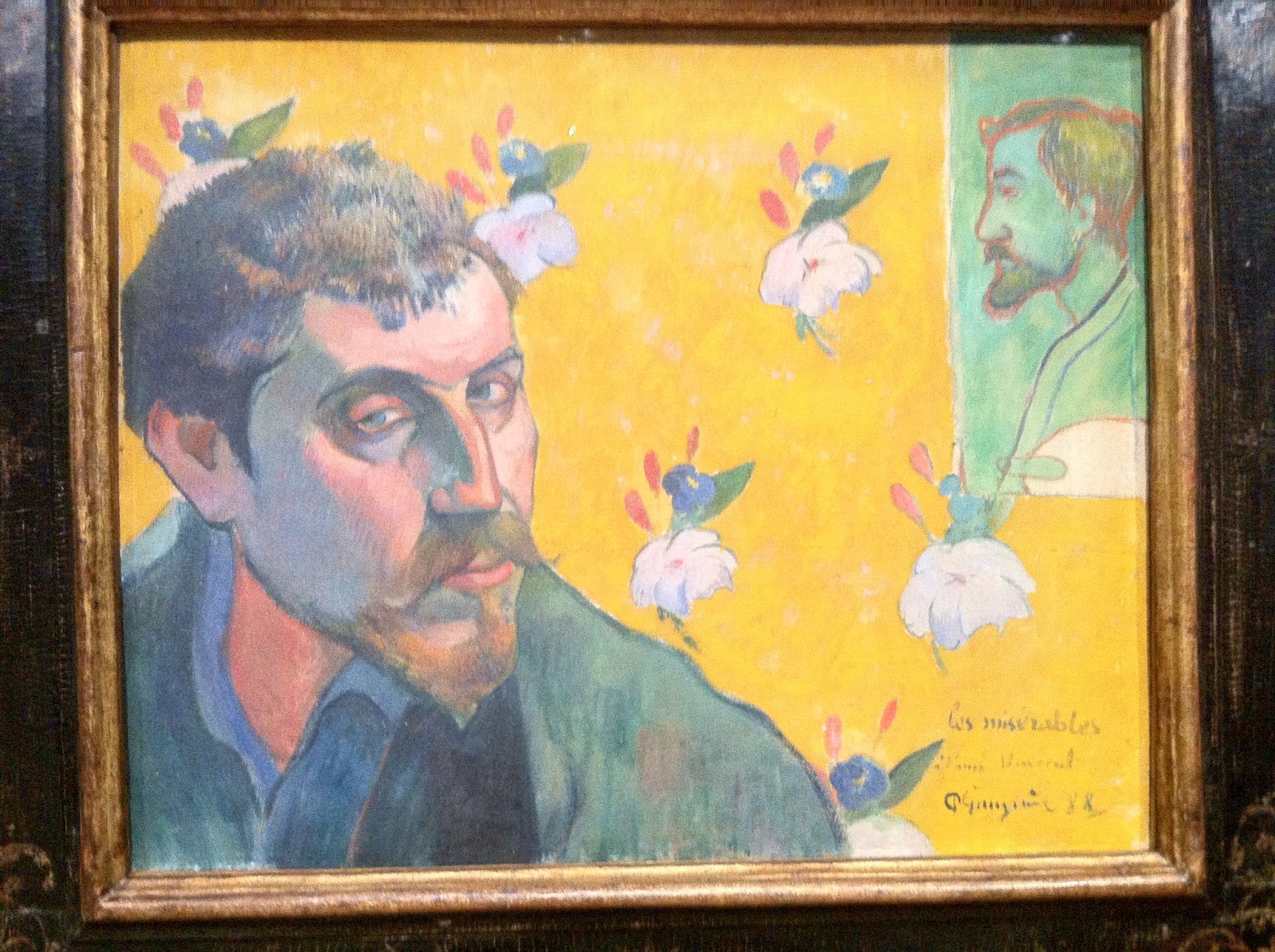
In addition to the famous two-month living arrangement with Paul Gauguin in Arles (for which occasion he painted the series of sunflower pictures), Vincent had other relationships with painters, including Emile Bernard (1868-1941). Vincent asked Gauguin and Bernard for their self-portraits in a trade, and those paintings are on display (with each of them showing the other in the background).

Paul Gauguin (1848-1903), Les Misérables
 (Self-portrait with portrait of Bernard)


Repeatedly in the exhibit, conservators site examples of paint analysis, such as the 'grains of sand and bits of grass and leaves' 'discovered in the paint layers of some of his works' that indicate the artist worked outside on some canvases (Van Gogh at Work Highlights, page 6). Research showed that Vincent re-used materials -- x-ray photographs and pigment analysis showed that the artist painted over pictures to save money on purchasing new canvases (as it was he often felt guilty for purchasing supplies on the limited funds his brother Theo sent him, according to Vincent's letters).

Metal Detectors at the VGM


The Van Gogh Museum uses metal detectors to screen visitors (the Rijksmuseum does not); all restrooms are located in the basement of the four-story building (the Rijksmuseums places toilettes in pairs on each floor); and the cafeteria and large seating area accommodates crowds quickly (lunch at the cafe at the Rijksmuseum can take an hour). But both museums give the option for female security guards to wear scarves instead of ties (just saying).

Discussion of security can be summed up by a comment from another security museum official:
As you may know, we never speak about our security in public. But in general, I can tell you that one of the main challenges for every museum is to create the optimum balance between protecting the collection and offering the best hospitality for all visitors.
And with free Wi-Fi, the Van Gogh Museum also encourages visitors to promote the institute through social media.

The exhibit ended with 'probably' the last known painting by Vincent Van Gogh, Tree Roots, 1890: "He did not complete it: the top is almost finished, but the lower half had not yet been worked out in detail."

Vincent Van Gogh, Tree Roots, 1890
The exhibit is a result of the research project 'Van Gogh's Studio Practice', initiated in 2005 by the Van Gogh Museum, the Cultural Heritage Agency of the Netherlands and Shell Netherlands. A symposium on the subject is scheduled for June 24-26, 2013.
Read More
Posted in art conservation, museums, research, Vincent van Gogh | No comments

Saturday, 15 June 2013

Amsterdam Diary: Visiting the newly opened Rijksmuseum is worth the stopover (and the day)

Posted on 22:06 by Unknown
Inside the Rijksmuseum bike tunnel
by Catherine Schofield Sezgin, ARCA Blog Editor-in-chief

SUNDAY, Amsterdam - Saturday morning I avoided getting lost cycling through Amsterdam by using the Google maps I had printed out before I'd left home. I stopped by De Bakkerswinkel for thick buttered raisin bread and a latte for breakfast -- a crucial element as the newly renovated Rijksmuseum has only one cafe for food and drinks. A section inside is set aside for "picknicks" so visitors can bring in food and water (I never found any water fountains).

Crowd at Rembrandt's
 Night Watch extends all day
Visitors do have the option of leaving for outside venders and then re-entering the museum on the same ticket. I stopped for food and drink at about 1 p.m. after completing the 90-minute Multimedia Tour on the "Golden Age" of Dutch art (it took me twice the time since I looked at other works in passing). The line at the cafe was long, so I returned to the galleries for another audio tour that highlighted the collection. I spent another two hours looking at the art before returning to a less crowded cafe for a seat at a communal table and a recommended smoked mackerel tartare. The Rijksmuseum does accommodate long visits in the museum with plentiful sofas strategically placed in front of great art for relaxing views.

The crowd in front of the Vermeer paintings
The renovated Rijksmuseum offers improved lighting (large skylights augmented by lights by Phillips) and more room to display the collection. The crowds have increased in front of the four paintings by Vermeer, Rembrandt's Night Watch, and three paintings by Van Gogh. A couple of years ago on a Sunday morning my family and I had found ourselves almost alone with these same paintings. However, the galleries are well ventilated and climate controlled and a visible force of smartly uniformed security guards manage the increased number of visitors. I did manage to sneak a few good photographs of the Vermeer paintings and Rembrandt's masterpiece in the last 15 minutes before the museum closed.

Jan Asselijn (1610-1652),
The Threatened Swan, 1650
The art is incredible. In Southern California we have numerous examples of Rembrandt's work from The Getty to the Timken Museum in San Diego, but the artist's work at the Rijksmuseum against other great Dutch work highlights his genius. It's worth the trip to Amsterdam to gain a greater understanding of why Rembrandt has endured -- even the few etchings displayed are impressive -- and influenced so many artists.

Biblioteek open to public
One of the benefits of the renovation is that lesser known works can again be displayed. For example, paintings by father and son Jozef and Isaac Israels can now be seen after years in storage. And the Gallery of Honour highlights paintings in the vast collection for easy viewing. For years my husband had remembered a painting from his last visit -- that of a large white swan with opened wings -- and I was able to show him the painting via Skype and the free Wi-Fi provided throughout the Rijksmuseum.

The multi-story library (biblioteek) is open to the public with available seating at tables for reading current art periodicals. 

The Multimedia tour is available for five euros at the Rijksmuseum or you can download it for free on your smartphone.

A distinguished gentleman and Rembrandt's Night Watch before closing.

Read More
Posted in art security, Rembrandt, Rijksmuseum, Vermeer | No comments

Carabinieri Headquarters for the Protection of Cultural Heritage Publishes Annual Bulletins of Stolen Art Online

Posted on 20:37 by Unknown
Ton Cremers for Museum Security Network sent out a valuable link to "Art in Ostaggio - Art in Hostage", bilingual bulletins of stolen works of art prepared by the Comando Carabinieri Tutela Patrimonio Culturale from 2004-2012 designed to combat against the worldwide problem of the illegal art market.

The 124-page report for 2012 includes a statement from the Carabinieri Headquarters for the Protection of Cultural Heritage:
We believe that what has been stolen must not be considered as lost forever. On the contrary, we regard it as held hostage by offenders who can and must be defeated by the Italian and international police force, together with the Ministry of Culture, the art dealers and all the citizens.
The information for each stolen object registered includes: artist or school (with indications limiting or the fining its paternity, such as: attributed to, workshop of, copy by, etc.); title or subject of the work; material and technique of execution; Dimensions; carabinieri databank reference number; and images.

The report is divided into archaeology; woodwork; ecclesiastic objects; painting; and sculpture. The report concludes with an index of the stolen works and a list of recovered artworks reported in the Bulletin's previous issues.

A year-in-progress list for 2013 reports the recovery of 10 objects previously identified in earlier bulletins.
Read More
Posted in Carabinieri Art Squad, Carabinieri Tutela Patrimonio Culturale, Stolen Art Bulletins, Stolen Art Recovered | No comments

Friday, 14 June 2013

Amsterdam Diary: Personal suffering displayed at World Press Photo Exhibit Amidst Red Light District

Posted on 22:29 by Unknown
World Press Photo Exhibit at De Oude Kerk, Amsterdam
by Catherine Schofield Sezgin, ARCA Blog Editor-in-chief

SATURDAY, Amsterdam - Yesterday I arrived in Amsterdam and biked over to the World Press Photo exhibit at De Oude Kerk ('The Old Church') in the Red Light district famous for women selling their bodies in front windows and customers smoking marijuana in coffee shops.

The inside of the oldest building in Amsterdam (1300), De Oude Kerk is an impressive setting to display award-winning photographs from 2013 and the auxiliary exhibit, 'World Press Photo Laureates From Russian and the Soviet Union, 1956-2013.'

Rembrandt's wife Saskia is buried here.
Of particular interest to art history buffs, this is the church where Rembrandt received permission to marry Saskia van Uylenburgh (died 14 June 1642) and where she lies buried underneath a modest slab. Just as the church connects visitors to more than 700 years of Dutch history, the photo exhibit serves as a humble memorial to personal suffering in 2012.

Here's a link to the 2013 Photo Contest (winners were selected from over 100,000 images). The World Press Photo of the Year went to Swedish journalist Paul Hansen for Gaza Burial, 20 November 2012, in the Palestinian Territories, that showed two men carrying the bodies of two children through the street in a funeral procession. All the photos, such as scenes from the civil war in Syria to women who dare to play basketball in Somalia to a mother and daughter who survived an acid attack in Southern Iran, are accompanied by just enough information likely to draw visitors back to the news. These photographs make suffering personal.

Inside 'The Old Church'

Information accompanying photographs by Danish photographer Jan Grarup: 'Even though Somalia's UN-backed government has regained control of the capital Mogadishu, al-Qaeda-linked militants are still active in the city. Al-Shabaab and other radical Os;a,oc groups consider women playing sport to be un-Islamic. Members of the Somali national women's basketball team have received death threats.' The women have taken precautions. 'Team members have to exercise extreme discretion. They go veiled and conservatively dressed in public, and carry basketballs deep inside their bags.'

The Russian exhibit showed the passage of time, including toddlers learning to swim before walking (1979); the image of a deformed horse as a consequence of the nuclear explosion of Chernobyl in 1986; and from Georgia celebrating its membership as a Soviet bloc country in 1981 to its civil war in 1991.

The 2013 World Press Photo Exhibit will travel to 100 cities in 45 countries.
Read More
Posted in Amsterdam, Rembrandt, World Press Photo Exhibit | No comments

Thursday, 13 June 2013

Report from Amelia: ARCA Intern Sophia Kisielewska Writes about Dr. Tom Flynn's "Art & Business" Course

Posted on 00:00 by Unknown
Photo of ARCA Class 2013
by Sophia Kisielewska, ARCA Intern

Art Historian Dr. Tom Flynn led the first course of ARCA's Postgraduate Certificate Program in International Art Crime and Cultural Heritage Protection Studies.

Dr. Flynn, a London art lecturer and docent, began "The International Art Market and Associated Risk" on Monday by asking the students to consider the question ‘what is the relationship between economic and aesthetic value’.  During the week he went through the history of the art market and explored how ideas of value were initially generated and understood within it.  The class looked at how the fashion for Cabinets of Curiosity stimulated an interest in enlightened thought and then later in the 18thcentury how the first auction houses in London, Christies and Sotheby’s, stimulated an interest in creating collections of art.  We learned how the desire to form collections of all things Classical and Italian was initiated by the travels made by the young aristocracy that had travelled to Greece and Italy on their ‘Grand Tours’.

With his vast experience in the art market Dr. Flynn guided the class through its complex structure, explaining the contemporary significance and ever-evolving roles of every faction: the auction houses, the art dealers, art collectors, museums and the art media.  He created a very easy atmosphere for debate and discussion and right from the off everyone was keen to contribute knowledge gained from their different experiences of the market. The vibrant mix of nationalities and expertise in the class made for a fascinating arena of discussion and those with specialist areas of knowledge brought valuable insights to share with the class, such as Anna Knutsson who, having worked as a researcher and cataloguer at The Smith Library and former Sales-room assistant at Christies, has had a lot of experience in the market of books and manuscripts.

Students also shared their own cultural/national perspectives.  Mink Boyce, a gallerist and art consultant from Auckland, shared her experiences of working in the New Zealand art market.  She spoke of the complicated ethical issues surrounding the trading of traditional Maori art, and the need for greater cultural sensitivity in the art market when dealing with such works.  This discussion arose from a mention of the recent controversial sale in Paris that auctioned off Native American Hopi and Zuni tribal masks. 

Every day after class, the debates have been transferred with enthusiasm to either Punto di Vino – a sophisticated wine bar just around the corner that welcomes the ARCA students like family -- or Bar Leonardi – a bar placed just outside the gate which offers an authentic Italian bar experience.

On Tuesday morning, Monica Di Stefano (ARCA’s resident Amerino) directed those who had signed up for Italian lessons in their first ciao’s and mi chiamo’s.  Armed with their exercise books, the students moved very speedily through the basics and by Thursday morning could be seen rushing into Caffe Grande before class to confidently test out their new skills on Massimo, everyone’s favorite barista.

On Saturday, at 7.45 a.m., more than 20 students made their way by bus to the beautiful Umbrian town of Orvieto. Monica Di Stefano, the trip’s tour guide, spoke of the city’s history from its inception as a major Etruscan settlement to its interesting relationship to the papacy in the Renaissance period and to being the one-time home of Thomas Aquinas.  The highlight for all the students seems to have been  Luca Signorelli’s astonishing San BrizioChapel in the Duomo, whose powerfully exaggerated nudes are famously thought to have been inspiration for Michelangelo’s ‘Last Judgement’ fresco in the Sistine chapel.  When asked about the trip, ARCA student Georgina Roberts said, ‘A quaint town with astronomical amounts of culture… and great ice cream’.

That evening many ARCA students joined the locals of Amelia in a pizza evening hosted by the ‘Collis’ contrada.  Amelia, like many medieval towns of Italy, such as Siena, is divided into condrade, and these zones of the city compete in various medieval events throughout the year.  The evening was finished off with music and a raffle, where ARCA student Sloane Taliaferro won third prize: a snazzy beach-bag and tights.

By Sunday everyone seemed a bit exhausted. Most people were seen taking it easy in the sun - when it wasn’t raining - but a few were hurriedly finishing their assignments for Dr. Flynn or desperately flicking through Noah Charney’s book Stealing the Mystic Lamb in preparation for Monday’s class.

Sophia Kisielewska recently finished her MA History of Art degree from the University of Edinburgh , which included a year of study at the Universita' di Roma Tre.

Read More
Posted in ARCA 2013, Art & Business, Tom Flynn | No comments

Friday, 7 June 2013

Retired Dutch Policemen Dick Steffens and Juul van der LInden's Form Private Detective Agency Missing Art

Posted on 14:43 by Unknown
by Catherine Schofield Sezgin, ARCA Blog Editor-in-Chief

Two former Dutch policemen, Dick Steffens and Juul van der Linden, have formed Missing Art, a private detective agency dedicated to finding lost or stolen art.

Steffens and van der Linden met in the detective school 1979 for the Amsterdam Police. “In the Netherlands, all policemen start in uniform with the normal police work,” van der Linden explained in an email. “After years you may specialize if you want.”

A few years after helping to ransom the kidnapped Alfred Heineken in 1983, Dick Steffens started his own detective agency, Interludium International BV, specializing in counterfeit clothes and shoes. Two years after Juul van der Linden retired from the Amsterdam police force, he helped Dick Steffens set up Missing Art. Juul van der Linden manages the department of Missing-Art for the Interludium Investigations Group. Here’s a link to their website, www.Missing-Art.com.

“In the Netherlands, there are not many private organization that find lost or stolen art,” van der Linden wrote.

I conducted an interview via email with Mr. van der Linden. 
If I were living in Amsterdam and had my painting stolen, would my first step be to report it to the police? What kind of action would then I then expect from the police?
One of the board members of the Dutch Federatie TMV (www.tmv.nl) once wrote that is was no use to go to the police to make a report when your painting is stolen. This was a statement made a few years ago, but with a lot of truth to it. At this moment I think there is insufficient knowledge of the world of art by the police force in Amsterdam. In the rest of the Netherlands, it is not better, although the Amsterdam police contracted three years ago with Mrs. Godthelp to start a better way to solve art crimes. She will make the first steps to making policemen on the front line aware of art crimes and that will take time.

The Dutch police have a unit working for the whole country, which is called KLPD. Mr Martin Finkelnberg with his team is making art crime visible with a computer.
What services does your private organization offer that the Dutch police cannot provide?
Missing Art can work faster and can in short time contact its network of experts. We also have frequent contact with our clients. We tell them step by step what we are going to do and we will have their support for that.
How does Art-Alert.net work? Is this service just in Europe? Does it have any connection to the Art Alerte in Canada?

Our Art Alert is ready to operate. In the last two years we collected more than 12,000 names of art collectors, auction houses and so on. At this moment we can warn in Belgium, the Netherlands and Luxembourg (BeNeLux). We will like to expand this service to more countries in Europe and perhaps worldwide. We do not have connection to the Art Alerte in Canada.
Read More
Posted in Amsterdam, Art Alert, Martin Finkelnberg, The Netherlands | No comments

Thursday, 6 June 2013

Report from Amelia: ARCA Intern Summer Kelley-Bell on ARCA Orientation for the 2013 Program

Posted on 03:37 by Unknown
ARCA Interns in Cisterne Amelia
May 28th marked the beginning of the summer adventures for ARCA’s 2013 group of interns. In this year’s batch, we have three student interns: Yasmin Hamed, Summer Kelley-Bell, and Sophia Kisielewska. They are joined by Laura Fanadino, an undergraduate from Wellesley, and Kirsten Hower, ARCA’s 2013 Program Assistant, who is in her third year of working with the program. Each week, this lovely group of ladies is going to be bringing you insight into the program and some of its behind the scenes happenings. To start you off, Hello! My name is Summer Kelley-Bell and I’m from Chattanooga, Tennessee. Now let’s jump straight in to ARCA’s program.

The week started off with a few bumps along the way as the interns were reminded that Italian time runs a bit differently than any other time. Thankfully, we had arrived a bit early in order to work out the kinks and we have quickly adapted to the way a small town runs. Amelia is situated on top of a hill. Through the initial getting to know you stages between the interns, there was also the opportunity to get to know this fascinating town. Each day that we walked through the Porta Romana on our way to the library for work, we were also walking past a section of Roman road that has been paved around. It has been preserved so that future visitors to the city, or in fact its current inhabitants, can appreciate the history of this hilltop town. 

The official arrival day for the students wasn’t until the 31st, so we had a few days to get ourselves situated. We have checked out the grocery stores; sampled the wares at Bar Massimo, a local café; and headed down to Dixie, where Sophia and Laura successfully navigated the purchase of internet keys. These “chiavetti” allow students to plug in a kind of thumb drive to their computers so that they can have internet anywhere there is a signal. All of these things were done in preparation for the arrival of the students. 

Friday the 31st was arrival day and it could have been a hectic day but it turned out quite well. Everyone banded together to navigate getting students from all over the world settled into their various Amerini apartments. Thankfully, the early arrival of the interns and the director, along with the help of Monica Di Stefano, the Amelia-based Social Director and Assistant, helped insure that everyone was safely placed in their homes. We met up later at La Locanda to officially welcome everyone to Amelia and to the program. This local restaurant has played host to ARCA in the past and it never disappoints. A large group of the students even stayed after the welcome cocktail had wound down in order to avail themselves of some of Locanda’s delicious food. 

Despite only being in the town for a brief period of time, students had very little problem finding their ways to the meeting point Saturday and then heading in to one of our classrooms for orientation. We heard speeches from the director and her various assistants, as well as a few words from Crispin Corrado, ARCA’s Acting Academic Director. Then the floor was given over to the students and we had a chance to get to know each other a little bit better. Saturday was given over to the idea of getting to know each other and the town and the interns even took some of the students on an optional walk to show them where to buy groceries and other such necessities.

However, the intern-led walk paled in comparison to Monica Di Stefano’s walk on Sunday. June 2nd marked “Corpus Domini,” a religious festival in Amelia where the streets are decorated with flower petals. Many of the students jumped at the chance to participate in this day and could be seen helping the locals to create rose petal angels and the like. We then had a walk around the city where Monica explained more of its history and grandeur. Monica showed us some of the wonderful little secrets that Amelia has to offer.

This year’s group of students comes from a variety of different backgrounds and places. They have come together from around the world to learn about something that interests each of us in different ways. This diversity is sure to translate into a very interesting program as each person brings their own unique experiences to the classes. I, for one, cannot wait to see where this will lead.
Read More
Posted in Amelia, Porta Romana | No comments

Monday, 3 June 2013

ARCA's Postgraduate Certificate Program in Art Crime and Cultural Heritage Protection Begins Today

Posted on 00:30 by Unknown
2013 ARCA Course Faculty and Schedule

Course I - June 3-7  “The International Art Market and Associated Risk”
Dr. Tom Flynn, London Art Lecturer, Docent and Art Historian

Course II - June 10-14   “Art Crime and its History”
Dr. Noah Charney, Founding Director of ARCA - Adjunct Professor of Art History, American University of Rome 

Course III - June 17-21  “Transnational Organized Crime and Art”
Dr. Edgar Tijhuis, Lawyer and Assistant Professor of Criminology at the VU University in Amsterdam 

Courses IV - June 24-26 and July 1-3  “Art Crime in War”
Judge Arthur Tompkins, District Court Judge in New Zealand

Courses V - June 26-28 and July 3-5  “Art and Heritage Law”
Dr. Derek Fincham, ARCA Dissertation Advisor and Assistant Professor of Law, South Texas College of Law

Courses VI - July 06 -10  “Risk Assessment and Museum Security”
Dick Drent, Director of Security, Van Gogh Museum, Amsterdam 

Course VII - July 17-19 and 24-26 “Cultural Security”
Dr. Erik Nemeth, Adjunct Staff at RAND Corporation, Founder and Researcher at Cultural Security 

Course VIII - July 22-24 “Insurance Claims and the Art Trade”
Dorit Straus, Vice President and Worldwide Specialty Fine Art Manager for Chubb & Son, a division of Federal Insurance Company

Course IX - July 29-31 and August 5-7 “Antiquities and Identity”
Dr. Valerie Higgins, Associate Professor and Chair of Archaeology and Classics at the American University of Rome

Course X – July 31-August 2 and August 7-9  “Art Policing, Protection and Investigation”
Richard Ellis, Detective (retired) and founder of Scotland Yard’s Art and Antiquities Squad,

Art Management Group Director

Here's a link to the ARCA website and more information on the program.
Read More
Posted in 2013, ARCA | No comments
Newer Posts Older Posts Home
Subscribe to: Comments (Atom)

Popular Posts

  • What Happened When Myles J. Connor, Jr. Spoke at the Milton Art Center in MA
    Myles J. Connor, Jr. & columnist Suzette Martinez Standring By Suzette Martinez Standring (suzmar@comcast.net) The flak and hubbub have ...
  • Enez: Bulgaria - Turkey IPA Cross-Border Program Highlights Multicultural History of Castle Ruins in Northern Aegean Beach Town
    Enez Castle (Acropolis) - Restored by Turkish Ministery of Culture and the Department of Cultural Assets & Museums  by Catherine Sezgin,...
  • 2013 ARCA Art and Cultural Heritage Conference: Senior Police Inspector Toby Bull on “Property of a Hong Kong Gentleman, Art Crime in Hong Kong – Buyer Beware”
    Toby Bull ARCA’s Art and Cultural Heritage Conference (June 21-23, 2013), held in the ancient Umbrian town of Amelia, began with cocktails f...
  • Felicity Strong on "The Mythology of the Art Forger" in the Fall 2013 issue of ARCA's Journal of Art Crime
    Felicity Strong uses the biographies of Han van Meegeren and Elmyr de Hory, amongst others, in her academic article on "The Mythology ...
  • From Outside Neolithic Walls: It’s a Matter of Scale and Resources*
    Participants attending PRTP-Zagreb from March 10-15, 2013 Source: Holocaust Art Restitution Project by Martin Terrazas, ARCA Class 2013 This...
  • Kenya's Dr. George H. O. Abungu Wins 2012 ARCA Award for Lifetime Achievement in Defense of Art
    ARCA (the Association for Research into Crimes against Art) is pleased to announce the winners of its annual awards for the year 2012. ARCA...
  • Was the repatriation of a footless 10th century statue to Cambodia this month related to Sotheby's history of selling Khmer pieces with "no published provenance" or "weak" collecting histories?
    This month's repatriation of a 10th century footless sandstone statue looted from an archaeological site in Cambodia has a backstory goi...
  • Gurlitt Art Collection: English language media reports German government to cooperate with publicizing art works
    theguardian.com published a report today by the Associated Press under the headline: " German government unveils details of 'Nazi...
  • The Monuments Men: Harry Ettlinger describes finding the stained glass windows of Strasbourg Cathedral in a salt mine
    Here's an eight minute video produced by Roberta Newman for the American Jewish Historical Society on activities of The Monuments Men wh...
  • Kunsthal Rotterdam Art Heist: Looking at the Paintings Stolen from the Triton Foundation (Provenance Information Added)
    Lucian Freud, Woman with Eyes Closed by Catherine Sezgin, ARCA Blog Editor The seven paintings stolen from the Kunsthal Rotterdam on October...

Categories

  • "toxic" antiquities
  • 1911
  • 1954 Convention
  • 1970 Convention
  • 1970 UNESCO Convention
  • 1971 theft
  • 19th century
  • 2012
  • 2012 ARCA Award nominations
  • 2013
  • 2013 ARCA Annual Art And Heritage Conference
  • 2013 ARCA Award Winners
  • A.M.C. Knutsson
  • Adam and Eve
  • Adam Worth
  • Adele Bloch-Bauer
  • advisory panels
  • Afgan Archaeology Office
  • Afghanistan
  • Africa
  • After the Bath
  • Agrigento Ephebe
  • Alain Dumouchel
  • Alain Lacoursière
  • Alceo Dossena
  • Alfred Flechtheim
  • Altman
  • Ambroise Vollard
  • Amelia
  • American Greed
  • American Institute of Roman Culture
  • Amsterdam
  • Anders Burius
  • Andrea Meldolla
  • Andrew Higgins
  • Andy Warhol
  • Ann Shaftel
  • Anne-Marie O'Connor
  • annual conference
  • Anthony Amore
  • antiquities
  • antiquities looting
  • antiquities recovered
  • Antiquities Trade
  • Antonio Diziani
  • appeal
  • Apulian Gnathia
  • ARCA
  • ARCA 2011
  • ARCA 2012
  • ARCA 2012 masters
  • ARCA 2013
  • ARCA 2013 Conference
  • ARCA alum
  • ARCA Annual Conference
  • ARCA Art Crime Scholarship
  • ARCA Awards
  • ARCA Board of Trustees
  • ARCA CEO
  • ARCA Trustee
  • ARCH
  • archaeological artifacts
  • archaeological sites
  • Archaeology
  • Archeology
  • archives
  • armed conflict
  • armed robbery
  • Armenia
  • arson
  • art
  • Art & Business
  • Art Alert
  • Art and Heritage Law
  • Art and Law Policy
  • art and organized crime
  • art auctions
  • art authentication
  • art collecting
  • art conservation
  • Art Cops
  • art crime
  • art crime conference
  • art crime expert
  • art crime in war
  • art crime lecture
  • art crime statistics
  • art damage
  • art dealers
  • art destruction
  • art destuction
  • art expert
  • art forgery
  • art fraud
  • Art Guard
  • art heist
  • art historians
  • Art history
  • art hostage
  • art insurance
  • art law
  • Art Law and Policy
  • Art Loss Register
  • art policing
  • Art Policing and Recovery Award
  • art restitution
  • art restorer
  • art security
  • art theft
  • art theft anniversary
  • art theft arrests
  • art theft in film
  • art theft prosecution
  • art thief
  • art thieves
  • art trade
  • Artemisia Gentileschi
  • Arthur Brand
  • Arthur Tompkins
  • artifacts
  • ARTINFO
  • artists
  • ARTnews
  • Asia
  • Asian Studies
  • askos
  • Assyrian
  • astrolabe
  • Athens
  • Athlete of Fano
  • Auckland Art Gallery
  • auction house thefts
  • auctions
  • Augsburg
  • Augsburg prosecutor
  • Australia
  • Austria
  • authenticity
  • autographic arts
  • Aviva Briefel
  • Award for Art Protection and Security
  • Axum Obelisk
  • Azerbaijan
  • Babylon
  • Baltimore Art Museum
  • Banknotes
  • Banksy
  • Bar Leonardi
  • Battle of Anghiari
  • BBC
  • Becchina
  • Belgium
  • Beltracchi
  • Benin
  • Bernard Ternus
  • Bhutan
  • bicycling thieves
  • Bill Anderson
  • Bill Martin
  • Bill Reid
  • Bill Wei
  • Biltmore House
  • blackmail
  • Blanca Niño Norton
  • Bob Combs
  • Boijmans
  • Bolivia
  • Bonnie Czegledi
  • book review
  • Book Soup
  • book theft
  • books
  • Bosnia
  • Boston Globe
  • Boston MFA
  • Braque
  • Brent Huffman
  • Brighton Knockers
  • Britain
  • british museum
  • Broken Windows
  • Brueghel
  • Bucharest
  • Buddhas of Bamiyan
  • Buddhism
  • Bührle
  • burglary
  • Cairo
  • Calabria
  • Caledonian Boar Hunt
  • California
  • California law
  • Call for Papers
  • Cambodian art
  • Campania
  • Canada
  • Capitoline Museum
  • Carabinieri
  • Carabinieri Art Squad
  • Carabinieri Tutela Patrimonio Culturale
  • Caravaggio
  • Castel Sant'Angelo
  • Castellani
  • Catherine Sezgin
  • Catherine Whitney
  • Caveat Emptor
  • Cellini's Saliera
  • certificates of authenticity
  • Cezanne
  • Chappell
  • CHAPS conference
  • Charles A. Loeser
  • Charles Frederick Goldie
  • Charley Hill
  • Chasing Aphrodite
  • China
  • Chinese antiques
  • chris marinello
  • Christie's
  • Christopher Marinello
  • Christos Tsirogiannis
  • Church
  • city bankruptcy
  • civil forfeiture
  • Claude Picasso
  • Cleveland Apollo
  • Colgate University
  • collateral damage
  • collecting history
  • collections online
  • combat
  • Conference of Protection of Cultural Property in Asia
  • conferences
  • connoisseur
  • connoisseurship
  • conservation
  • Context Matters
  • convictions
  • copies
  • Cordoba
  • Cornelius Gurlitt
  • Corot
  • Corsica
  • Counterfeit Art
  • Counterfeit Money
  • counterfeiters
  • counterfeiting
  • Courbet
  • Courthouse News Service
  • credit fraud
  • criminal investigation
  • Criminals
  • criminology
  • Crispin Corrado
  • Croatia
  • cross-stones
  • crowdsourcing
  • cultural heritage
  • cultural intelligence
  • cultural landscapes
  • Cultural Plunder Database
  • cultural property
  • cultural property crimes
  • Cultural Property Panel
  • Cultural Property Protection
  • cultural property returned
  • Cultural protection
  • cultural repatriation
  • cultural restoration
  • cultural security
  • Curator of Provenance
  • customs
  • Dallas Museum of Art
  • Dan Brown
  • Daniel Silva
  • Danny Boyle
  • Daubert
  • Daumier Register
  • david gill
  • David Turner
  • De Spiegel
  • deaccession
  • deadbolt
  • Degas
  • DePaul
  • Derek Fincham
  • destroying stolen art
  • destruction
  • Detroit Institute of Arts
  • Deutsche Welle
  • Dick Drent
  • Dick Ellis
  • Diego Rivera
  • dinosaurs
  • DIOCT
  • Diplomacy
  • Dirk Hannema
  • disaster relief
  • disputed art
  • documentary
  • Don Hrycyk
  • Donn Zaretsky
  • Donna Tartt
  • Dorit Straus
  • Dulwich Picture Gallery
  • Duncan Chappell
  • Dutch
  • Dutch Art Crime Team
  • Dutch Police
  • Easter
  • economy
  • Edinburgh
  • Edirne
  • Edmund de Waal
  • Eduardo de Valfierno
  • Education
  • Edvard Munch
  • Edward Forbes Smiley
  • Egon Schiele
  • Egypt
  • Eleanor and Anthony Vallombroso Award for Art Crime Scholarship
  • Elizabeth Royer
  • Elmyr de Hory
  • Enez
  • England
  • English law
  • Eric Hebborn
  • Erich Schlomovic
  • erik nemeth
  • Ernst Schöeller
  • Ernst Schöller
  • ERR
  • estimation
  • Ethiopia
  • Euphronios krater
  • European Union
  • evidence
  • executive director
  • exhibit
  • expert
  • expertise
  • Fabio Isman
  • fake
  • fakes
  • fakes and forgeries
  • Fall 2011
  • Fall 2012
  • Fall 2013
  • false insurance claim
  • Farrah Fawcett
  • FBI
  • FBI Art Crime Squad
  • federal rules of evidence
  • fingerprint
  • fire
  • fire alarms
  • flipper method
  • flipper theory
  • Florida
  • FOCUS
  • Foreign Cultural Exchange Jrisdictional
  • forensics
  • forged letters
  • forger
  • forger.
  • forgeries
  • forgery
  • Forum d'Avignon
  • Foundation E. G. Bürhle
  • Four Horses
  • French National Police
  • Fresch Palais
  • fundraising
  • Gabriel Allon
  • Gainsborough
  • galleries
  • Gardner Heist
  • Gavlebocken
  • gentleman thief
  • George Abungu
  • Georges Abungu
  • German forgers
  • Germanicus
  • Germany
  • Getty Museum
  • Getty Research Portal
  • Getty Villa
  • giacomo medici
  • Gianni Alemanno
  • Giles Waterfield
  • Giordano
  • Giorgio Vasari
  • Giovanni Bellini
  • Girl with a Pearl Earring
  • Giulio Carpioni
  • Giuseppe Medici
  • Glafira Rosales
  • Global Heritage Fund
  • glossary
  • Goddesses
  • Gold Rush
  • Goldfinch
  • Goya
  • Grand Mosque
  • Greece
  • Greek coins
  • Guatemala
  • Guggenheim
  • Guilia Rocco
  • guilty plea
  • gunpoint
  • Gurlitt art collection
  • Hammurabi
  • Han Van Meegeren
  • handbook
  • Hare with the Amber Eyes
  • HARP
  • Harry Ettlinger
  • Harvard
  • Hattusa Sphinx
  • Hawley
  • Headache Art
  • Helen Mirren
  • Henri Matisse
  • Herculaneum
  • high value art
  • HIldebrand Gurlitt
  • historical documents
  • holiday thefts
  • Holocaust Art Restitution Project
  • Holocaust restitution
  • Holocaust Restitution Project
  • Hong Kong
  • Honoré Daumier
  • Hot Art
  • Hôtel Lambert
  • Howard Spiegler
  • Hufnagel
  • Hugh Eakin
  • Hugo Simon
  • ICE
  • ICOM
  • iconoclasm
  • identification
  • IFAR
  • Il Veronese
  • Ilaria Dagnini Brey
  • Île St Louis
  • illegal actors
  • illegal trafficking
  • illicit antiquities
  • illicit art trade
  • illicit cultural property
  • illicit trafficking
  • Illuminated Manuscripts
  • immunity
  • in the media
  • Incallajta
  • Incan
  • Inferno
  • Insider theft
  • Integrated Risk Management
  • international
  • International Art Crime Conference
  • International Art Crime Tribunal
  • internet
  • Interpol
  • interview
  • Intifada
  • inventory
  • investigation
  • investigation problems
  • Ioana Patran
  • Irish Independent
  • Irish Travellers
  • Isabella Stewart Gardner Museum
  • ISGM
  • Islam
  • Israel
  • Istanbul
  • Istanbul Archaeology Museum
  • Italy
  • J. Paul Getty
  • Jacob Meyer De Haan
  • Jacques Goudstikker
  • James Alex Bond
  • James Cuno
  • James Moore
  • James Tissot
  • James Whitey Bulger
  • Jane A. Levine
  • Japan
  • Jason Felch
  • Jean Jacques Fernier
  • jean-francois talbot
  • Jeffrey Gundlach
  • Jeu de Paume
  • Jewelry
  • Joe Medeiros
  • John Daab
  • john drewe
  • John Kleberg
  • john myatt
  • John Pollini
  • John Singleton Copley
  • Jonathon Keats
  • Joris Kila
  • Joshua Knelman
  • Judge Arthur Tompkins
  • judith harris
  • Jugha
  • Julia Brennan
  • Julian Radcliffe
  • Jungle Scawlers
  • Kabul
  • Kait Murphy
  • Kanchipuram
  • Karl von Habsburg
  • Katie Ogden
  • Ken Perenyi
  • Ken Polk
  • Kenya
  • Khachqar
  • Khalil-bey
  • King Tut
  • Kirsten Hower
  • Klimt
  • Knoedler & Company
  • Krak des Chevaliers
  • Krieghoff
  • Kunsthal Rotterdam
  • Kunsthistorisches Museum
  • L'Origine du Monde
  • LA
  • LA Times
  • La Valette's Sword and Dagger
  • LACMA
  • Lady in Gold
  • LAPD Art Theft Detail
  • largest art theft in Canada
  • Larry Coben
  • Laura Rush
  • Laurie Adams
  • Laurie Rush
  • Laviano
  • lawyer's committee for cultural heritage preservation
  • Lea Bondi Jaray
  • Leila Amineddoleh
  • Leonardo da Vinci
  • Leopold Museum
  • Lessons from the History of Art Crime
  • Levy
  • Lifetime Achievement in Defense of Art
  • Llewelyn Morgan
  • local community
  • London
  • looted antiquities
  • looted art
  • Looted WII Art
  • Looting
  • Looting Matters
  • Lord Byron
  • Los Angeles
  • Lost Art Internet Database
  • Lost Princess
  • louvre
  • Lucas Cranach the Elder
  • Lucian Freud
  • Lucien Freud
  • Lucien Pissaro
  • Ludo Block
  • Lydian kline
  • Lynda Albertson
  • Lynn Nicholas
  • Maeve Sheehan
  • Maijer de Haan
  • Makkah
  • Malawai National Museum
  • Malawi National Museum
  • Mali
  • Malta
  • mana
  • Manders Collection
  • Maori
  • maps and manuscripts
  • marble monument
  • Marc Balcells
  • Marc Gabolde
  • Marc Masurovsky
  • Marcel Duchamp
  • Marconi University
  • Marei von Saher
  • Mari
  • Maria Altmann
  • Marianne Rosenberg
  • Mario Buagiar
  • Mariotto di Nardo
  • Mark Landis
  • market
  • Martin Finkelnberg
  • Martin Kemp
  • Matisse
  • Matthew Bogdanos
  • Mauritshuis
  • Maurizio Seracini
  • Max Libermann
  • Max Stern
  • Maya Widmaier-Picasso
  • Medici
  • Meg Lambert
  • Melanesian wood carvings
  • Melvyn Kohn
  • memoir
  • Mes Aynak
  • messenger bags
  • metal detectors
  • Meyer de Haan
  • Michel van Rijn
  • Michelangelo
  • micro-roughness
  • mineral museum
  • minor modes
  • Mizzi Zimmerman
  • MoMA
  • Mona Lisa
  • Mona Lisa Foundation
  • Monet
  • money
  • money laundering
  • Montreal Museum of Fine Arts
  • Monuments Men
  • Moshe Dayan
  • Moshe Rynecki
  • Mougins Museum
  • movies
  • Munich
  • murals
  • Musee d'Art Moderne de la Ville de Paris
  • Musée d'Orsay
  • Museo Thyssen-Bornemisza
  • museum
  • Museum Catharijneconvent
  • museum funding
  • Museum of Anthropology
  • Museum of Decorative Arts in Bergen
  • Museum of Modern Art in Sweden
  • museum security
  • museum theft
  • Museum thefts
  • Museum van Bommel van Dam
  • museums
  • music
  • Mussolini
  • Myles J. Connor
  • mythology
  • Napoli
  • Narni
  • National Etruscan Museum
  • National Gallery in Prague
  • National Museum of Scotland
  • National Museum of Serbia
  • National Stolen Art File Search
  • Nativity
  • Nazi art
  • Nazi art theft
  • Nazi-era looted art
  • negotiate
  • Neil Brodie
  • Nemetz
  • netsuke
  • new york city
  • New Zealand
  • news media
  • Nice
  • Nicolas Poussin
  • Niels Rutger
  • Noah Charney
  • North America
  • Norton Simon Museum
  • Norway
  • Norwegian Minister of Foreign Affairs
  • Novi Sad City Museum
  • Nuraghic bronze statuettes
  • NYC
  • NYTimes
  • Odyssey Marine
  • Okinawa
  • Olympia
  • Oplontis
  • organized crime
  • Ori Z. Soltes
  • Orpheus mosaic
  • Oskar Kokoschka
  • Oxford
  • Pablo Picasso
  • Padma Kaimal
  • painting analysis
  • Palais Fesch
  • Palermo
  • Palestine
  • Palmyra
  • Paolo Ferri
  • Parioli
  • Paris
  • partage
  • Pasadena
  • Patras
  • Paul Gauguin
  • Paul Hendry
  • Paul Rosenberg
  • Penny Jackson
  • People Not Stones
  • Permanenten Vestlandske Kunstindustrimuseum
  • Peru
  • Peter Paul Rubens
  • Peter Silverman
  • Peter Watson
  • petition
  • photographers
  • Picasso
  • pickpockets
  • Pico Iyer
  • plastic
  • Poland
  • Polaroids
  • police cooperation
  • police seizures
  • political economy
  • Pompeii
  • Port of Rotterdam
  • Porta Romana
  • Portrait of Wally
  • Post Certificate Program
  • preservation
  • press conference
  • Pretoria Art Museum
  • Princeton
  • private insurance
  • private policing
  • profilometry
  • prosecution
  • provenance
  • Provenance Research Training Program
  • psychology of forgers
  • public awareness
  • QDE process
  • Quebec
  • Quebec Art Crime team
  • Questioned Document Examination
  • Rachel Ruysch
  • Rajlich
  • Ralph Frammolino
  • Rape of Europa
  • rare maps
  • Rathkeal Rovers
  • RCMP
  • Rebecca Dreyfus
  • recovered cultural patrimony
  • Recoveries
  • recovery
  • religious art
  • Rembrandt
  • Renoir
  • renovation
  • repatriation
  • research
  • residential
  • restitution
  • Restitution Court
  • restoration
  • Reuters
  • reward
  • RFID
  • Rhino thefts
  • Richard Abath
  • Richard Ellis
  • Rick Abath
  • Rick St. Hilaire
  • Rijksmuseum
  • robbery
  • Robert Edsel
  • Robert Gentile
  • Robert Mang
  • Robert Volpe
  • Robert Wittman
  • Robin Symes
  • Rodolfo Siviero
  • Roman bronzes
  • Romania
  • Romanian Police
  • Rome
  • Rosa da Tivoli
  • Rossetti
  • roughness
  • Rudolf Leopold
  • Ruoppolo
  • Ruth Godthelp
  • S. 2212
  • Sackler Galleries of Art
  • sale of stolen paintings
  • Salvator Rosa
  • Sandy Nairne
  • Santa Monica
  • Sarajevo Haggadah
  • Sardinia
  • Sassari
  • Saving Italy
  • scandals
  • Schinousa archive
  • Scholarship - Books
  • Schoonhoven
  • Schubert at the Piano
  • Schwabing Art Fund
  • Schwabinger Kunstfund
  • Scotland
  • Scotland Yard
  • sculptor
  • Sea of Galilee
  • security
  • Security guards
  • security options
  • security specialist
  • sentencing
  • Serbia
  • Sharon Cohen Levin
  • shipwrecks
  • Sicilian Mafia
  • Sicily
  • Sisley
  • Skokloster Castle
  • smash and grab
  • smuggling
  • snuffboxes
  • sociology of crime
  • Sotheby's Auction
  • South Africa
  • South India
  • Spain
  • speaker
  • Spring 2013
  • spring/summer 2012
  • St. Patrick's Day
  • stamp theft
  • Stealing Rembrandts
  • Stefano Alessandrini
  • stele
  • Stockholm
  • stolen antiquities
  • stolen art
  • Stolen Art Bulletins
  • stolen art database
  • Stolen Art Recovered
  • Stolen Artwork Restitution Act
  • Stolen the film
  • Stonehill Art Crime Symposium
  • Stonehill college
  • street art
  • strikes
  • Stroganov Collection
  • stuart george
  • study of art crime
  • Stuttgart Fine Art and Antiquities Squad
  • summary
  • Sureté du Québec
  • surveillance video
  • Sussex Police Art and Antiques Squad
  • Sustainable Preservation Initiative
  • Sweden
  • Swedish Royal Library
  • Switzerland
  • Sydney
  • Symes
  • Symposium
  • Syria
  • ta moko
  • Takeaway Rembrandt
  • Taliban
  • Tauranga Art Gallery
  • tax fraud
  • Teddy Kollek
  • television
  • Tess Davis
  • textiles
  • Thailand
  • The Caravaggio Conspiracy
  • The Empty Frame
  • the Getty
  • the Journal of Art Crime
  • The Journal on Art Crime
  • the medici conspiracy
  • the met
  • the missing piece
  • The Monuments Men
  • The Netherlands
  • The New York Times
  • The New Yorker
  • The Palermo Nativity
  • The Rape of Europa
  • The Scream
  • The Venus Fixers
  • theft
  • Thierry Lenain
  • Thomas Kline
  • Timbuktu
  • Tom Flynn
  • Tom Keating
  • Tom Mashberg
  • Ton Cremers
  • TPC
  • Trance
  • Transnational crime
  • travel
  • treasure
  • Triamphal Quadriga
  • trickster
  • Triton Collection
  • Turkey
  • Typology of interfaces
  • U. S. Fish and Wildlife Service
  • U.S. News
  • UBC
  • Uffizi Gallery
  • UK
  • Ulrich Boser
  • Umbrians
  • undercover agent
  • UNESCO
  • United States
  • Universal Museums
  • University of Pennsylvania
  • Unlisted Conference
  • unsolved art theft
  • urgency
  • US law
  • V&A Symposium
  • Valerie Higgins
  • Van Gogh
  • Van Gogh Museum
  • Vancouver
  • vandalism
  • Veletrzni Palace
  • venice
  • Vermeer
  • vernon rapley
  • Victoria and Albert Museum
  • Victoria Reed
  • Victorian crime
  • Vienna
  • Viking artifacts
  • Villa Giulia
  • Vincent van Gogh
  • Vincenzo Peruggia
  • violin recovery
  • violin theft
  • Virginia Curry
  • Virginia Museum of Arts
  • Wales
  • Wall Street Journal
  • war booty
  • warrant
  • wartime losses
  • Washington DC
  • West Africa
  • Whicher
  • William Kingsland
  • wine fraud
  • Witches in Air
  • Worcester Art Museum
  • workshop
  • world heritage sites
  • World Press Photo Exhibit
  • World War II
  • writer in residence
  • Yale University
  • Zurich

Blog Archive

  • ▼  2013 (295)
    • ►  December (29)
    • ►  November (41)
    • ►  October (17)
    • ►  September (13)
    • ►  August (47)
    • ►  July (28)
    • ▼  June (16)
      • History of Art Crime: ARCA Student A. M. C. Knutss...
      • ARCA Alum Marc Balcells Speaks with artroop.com ab...
      • Il Tempo publishes piece on ARCA's Fifth Internati...
      • Week 3 from Amelia: ARCA Intern Yasmin Hamed on Dr...
      • Report from Amelia: ARCA Intern Yasmin Hamed
      • Amsterdam Diary: "Van Gogh at Work" rebukes myth o...
      • Amsterdam Diary: Visiting the newly opened Rijksmu...
      • Carabinieri Headquarters for the Protection of Cul...
      • Amsterdam Diary: Personal suffering displayed at W...
      • Report from Amelia: ARCA Intern Sophia Kisielewska...
      • Retired Dutch Policemen Dick Steffens and Juul van...
      • Report from Amelia: ARCA Intern Summer Kelley-Bell...
      • ARCA's Postgraduate Certificate Program in Art Cri...
      • Girl with the Pearl Earring and other Mauritshuis ...
      • The "Other" Dutch Paintings from the Mauritshuis T...
      • Journalist Tony Wall Interviews Judge Tompkins on ...
    • ►  May (14)
    • ►  April (21)
    • ►  March (35)
    • ►  February (19)
    • ►  January (15)
  • ►  2012 (205)
    • ►  December (8)
    • ►  November (20)
    • ►  October (36)
    • ►  September (12)
    • ►  August (19)
    • ►  July (26)
    • ►  June (19)
    • ►  May (27)
    • ►  April (21)
    • ►  March (17)
Powered by Blogger.

About Me

Unknown
View my complete profile