Recovery Vans

  • Subscribe to our RSS feed.
  • Twitter
  • StumbleUpon
  • Reddit
  • Facebook
  • Digg
Showing posts with label Fall 2012. Show all posts

Monday, 3 December 2012

The Journal of Art Crime, Fall 2012: Noah Charney's Q&A with Joshua Knelman

Posted on 00:00 by Unknown
In the Fall 2012 issue of The Journal of Art Crime, editor-in-chief Noah Charney interviews Joshua Knelman, a journalist living in Canada who's first book, Hot Art, is about investigating stolen art.  In it he profiles Don Hrycyk and follows the story of several heists and their subsequent investigations.  Along the way he speaks with a number of ARCA staff and colleagues.

"We chatted with Joshua about his research and how he came to write this book," Noah introduces.

Here's the first question Noah Charney asks Joshua Knelman:

Which art theft do you discuss in your book and how did you choose those cases in particular? With over 50,000 reported art thefts per year worldwide, and with the Carabinieri databased packed with over 3 million stolen artworks, it must have been tough to choose where to focus.
I chose to focus on cases related to me by a wide range of sources, and followed the threads, hoping to identify criminal patterns.  I was less interested in following one art theft case than in figuring out how art theft as a phenomenon works.  So it wasn't a matter of one particular case.  The book showcases a wide variety of art thefts ranging from blockbuster art heists, to art gallery smash and grabs, to the almost invisible plague of thefts from private residences.  It was this last category which seemed to be less covered, but persuasive.  When I began the book, I have to admit, I was hoping for a Thomas Crown Affair story I could follow, bu the reality turned out to be far more complex, and, to my mind, more interesting.
You may read the rest of this interview by subscribing to The Journal of Art Crime through the ARCA website.




Read More
Posted in Don Hrycyk, Fall 2012, Hot Art, interview, Joshua Knelman, Noah Charney, the Journal of Art Crime | No comments

Friday, 30 November 2012

The Journal of Art Crime, Fall 2012: "The Hattusa Sphinx and Turkish Antiquities Repatriation Efforts" by Aaron Haines

Posted on 00:00 by Unknown
In the Fall 2012 issue of The Journal of Art Crime, Aaron Haines writes about "The Hattusa Sphinx and Turkish Antiquities Repatriation Efforts":
On March 1 of 2012, Art News journalist Martin Bailey reported that the Turkish government had prohibited the loan of cultural artifacts to the New York Metropolitan Museum of art, the British Museum, and the Victoria and Albert Museum.  The Turkish Ministry of Culture and Tourism stated that these museums have artifacts that were illegally removed from Turkey, and that the ban would be removed once the contested objects were returned.  Soon it was discovered that Turkey had given the ultimatum to many other museums, including the J. Paul Getty Museum, the Cleveland Museum of Art, Dumberton Oaks, the Museum of Art at Bowling State University, the Louvre Museum, and the Berlin Pergamon Museum.  Turkey has prohibited exhibition loans to any of these museums until the requested objects have been returned. 
Turkey has been petitioning for the return of most of these artifacts for many years, but most often these petitions have come in the form of simple requests.  This is the first time that the country has made such a widespread and forceful demand.  This should not come as a surprise, in light of recent events regarding Turkey's repatriation efforts.  Of particular importance was its recovery of the Hattusa Sphinx, returned last year from the Pergamon Museum in Berlin.  Turkey was forceful with Germany, and the two countries were able to quickly come to an agreement.  This success emboldened Turkey and gave it the necessary confidence to use forceful tactics with other reluctant countries and institutions that own contested objects.  Exploring the motivations and actions of both parties involved with the Hattusa Sphinx will shed further light on why Turkey recently enforced this ban and what their plans are for the future.
Aaron Haines is a teaching assistant at Brigham Young University where he is pursuing a B. A. in Art History and Curatorial Studies.  He has worked at the Museo civico in Siena, italy as well at the Museum of Art at Brigham Young University.  He recently completed training with the Provenance Research Training Organization in Magdeburg, Germany and is a Foreign Language Area Studies Scholar.
Read More
Posted in antiquities, cultural repatriation, Fall 2012, Hattusa Sphinx, the Journal of Art Crime, Turkey | No comments

Monday, 26 November 2012

The Journal of Art Crime, Fall 2012: Review of Edmund de Waal's "The Hare with Amber Eyes: A Hidden Inheritance"

Posted on 00:00 by Unknown
In the Fall 2012 issue of The Journal of Art Crime, Catherine Sezgin reviews Edmund de Waal's The Hare with the Amber Eyes: A Hidden Inheritance (Picador, 2010).

Edmund de Waal is a British ceramic potter and academic uses the history of his family's netsuke collection to allow readers to understand this Japanese art in his memoir:
I pick one up and turn it around in my fingers, weight it in the palm of my hand.  If it is wood, chestnut or elm, it is even lighter than the ivory.  You see the patina more easily on these wooden ones: there is a faint shine on the spine of the bridled wolf and on the tumbling acrobats locked in their embrace.  The ivory ones come in shades of cream, every color, in fact, but white.  A few have inland eyes of amber or horn.  Some of the older ones are slightly worn away: the haunch of the faun resting on leaves has lost its markings.  There is a slight split, an almost imperceptible fault line on the cicada.  Who dropped it? Where and when?
The story involves 19th century Paris, Nazi occupied Vienna, and post-war Japan.

"Not since Jonathan Harr's book, The Lost Painting: The Quest for a Caravaggio Masterpiece, has a book so influenced me," Ms. Sezgin writes in the review.

Ms. Sezgin edits the ARCA blog.

You may read this article by subscribing to The Journal of Art Crime through the ARCA website.
Read More
Posted in art restitution, book review, Edmund de Waal, Fall 2012, the Journal of Art Crime, Vienna | No comments

Wednesday, 21 November 2012

The Journal of Art Crime, Fall 2012: "The Lord Byron Forged Letter: Where's the Questioned Document Analysis (QDE)?" by John Daab

Posted on 00:00 by Unknown
In the Fall 2012 issue of The Journal of Art Crime, regular contributor John Daab writes on "The Lord Byron Forged Letter: Where's the Questioned Document Analysis (QDE)?":
Lloyd Smith was an avid collector of rare books and letters amassing thousands of works upon his death.  In 1957 the Morristown National Historical Park Museum was elated to find that they were the recipient of 300,000 of Smith's works from his estate.  Contained with these artifacts was a letter from Lord Byron, the poet.  Over the last 40-50 years the letter was exhibited on occasion but, for the most part, it lay in storage (Pfister, 2011).  In 2010 the letter was scanned and brought to the attention of nearby Drew University scholars, who suspected that the work was not genuine (Appendix exhibit B). The evidence supporting the forgery call was that there were anomalies in signature, date, type of address to Captain hay (the receiver of the letter), and wording used.  The scholars argued that the signature was not that of Lord Byron, the dating of the months did not match Byron's dating, the word "affectionately" was not typical for Byron, and the use of "My dear Hay" to address Captain Hay his friend was not appropriate (Fischer, 2012 Appendix C).
To confirm the conclusion found by Drew Scholars, the National Historic Park Museum enlisted the services of Doucet Devin Fisher from the New York Public Library, a Byron scholar and member of the Byron Society.  Fisher compared the letter with the notes of a Rutgers University Byron scholar Leslie Marquand, and found that the letter was a forgery.  Fisher noted that the Byron letter under review matched a similar forgery.  What is not apparent from the various narratives and media accounts found regarding the announcement of the forgery, is a clear description of how the forgery was determined.  The fundamental rule in scholarly research and forensic examination is that another researcher may carry out the research in similar fashion and reach the same conclusion.  Verification informs reliability and, without it, specious conclusions may emerge.  What seems to be problematic and a serious issue is that those carrying out the process of document determination, in terms of authenticity, is the extent that the process establishing the forgery followed proper QDE, or Questioned Document Examination (FBI, 2009).  Before we engage in the QDE process ourselves, let us first define and discuss some of the concepts presented in the account of the latest Byron fake and those lacking in the examination.
John Daab was formerly a NYCTP Police Officer and an NYU Professor.  John holds the following designations: Certified Fraud Examiner, Certified Forensic Consultant, Certified Criminal Investigator, Certified Instructor, Diplomate American Board of Forensic Examiners, Certified Homeland Security, and Certified Intelligence Analyst.  He holds the degrees of Ph.D. MA, MPS, MA, MBA, and BA.  He writes regularly for The Journal of Art Crime.

Read More
Posted in Fall 2012, forged letters, John Daab, Lord Byron, QDE process, Questioned Document Examination, the Journal of Art Crime | No comments

Monday, 19 November 2012

The Journal of Art Crime, Fall 2012: "The Sword in the Museum: On Whether La Vallette's Sword and Dagger, Currently Housed in the Louvre, Should be Returned to Malta" by Mario Buhagiar

Posted on 00:00 by Unknown
In the Fall 2012 issue of The Journal of Art Crime, Mario Buhagiar writes on "The Sword in the Museum: On Whether La Valette's Sword and Dagger, Currently Housed in the Louvre, Should be Returned to Malta":
The debate about the spoils of war and national heritage is always an intense one.  Whenever I ask somebody whether a recognized objet d'art which used to be in a country's possession out to be returned to its first home, I always get a resounding 'yes.'  In Malta's case, the most popular objet d'art in question is La Valette's sword.  Together with its matching dagger, the sword was a gift from Philippe II of Spain in 1565 to The Grand Master of the Order of the Knights of Malta at the time, Jean Parisot De La Valette (active 1557-1568), marking the Knights of Malta's victory in the Great siege and the subsequent retreat of the Ottoman forces.(1) The set of weapons remained in the Order's possession for more than two hundred years after the death of the Grand Master, who first received it on the Order's behalf.  This sword was later taken by Napoleon's forces when they invaded Malta, and is now on display at the Louvre Museum in Paris.
Mario Buhagiar is a professor and head of the History of Art Department at the University of Malta.
Read More
Posted in Fall 2012, La Valette's Sword and Dagger, louvre, Malta, Mario Buagiar, the Journal of Art Crime | No comments

Friday, 2 November 2012

The Journal of Art Crime, Fall 2012: Columnist Noah Charney on "Counterfeit Money" in Lessons from the History of Art Crime

Posted on 00:00 by Unknown
In the Fall 2012 issue of The Journal of Art Crime, columnist Noah Charney writes on "Counterfeit Money" in Lessons from the History of Art Crime:
In this, and the last, issue of The Journal of Art Crime, we have seen excellent academic articles on aspects of counterfeit money (see Mihm, Stephen in the Spring 2012 issue, and Judson and Porter in this issue).  While counterfeit money is its own field of study, it has many parallels with art forgery, and we therefore have seen fit to consider it in this journal.  In doing so, I thought that it might be of interest to present a brief history of counterfeit money, for those unfamiliar with the subject. 
Perhaps the most well-known sort of forgery is the faking of money, whether counterfeiting coins, dollar bills, or treasury bonds.  The United States Secret Service, before they became best-known as the bodyguards of the president, were established in order to investigate counterfeit money printing operations and close them down.
Noah Charney is founder of ARCA and the Editor-in-Chief of The Journal of Art Crime.
Read More
Posted in Counterfeit Money, Fall 2012, Lessons from the History of Art Crime, Noah Charney, the Journal of Art Crime | No comments

Monday, 22 October 2012

The Journal of Art Crime, Fall 2012: Review of Anne-Marie O'Connor's "The Lady in Gold: Extraordinary Tale of the Klimt Paintings"

Posted on 13:15 by Unknown
In the Fall 2012 issue of The Journal of Art Crime, Catherine Sezgin reviews Anne-Marie O'Connor's The Lady in Gold: Extraordinary Tale of the Klimt Paintings (Knopf, 2012):
In 1907, Gustav Klimt finished the portrait of 24-year-old Adele Bloch-Bauer, the wife of a wealthy art patron who lived across the square from Vienna's Fine Art Academy.  In the same year, that same art school would reject Adolf Hitler's application for admission because he failed the drawing exam.  More than three decades later, these two events collided when a Nazi stole this portrait from the home of Ferdinand Bloch-Bauer, a Jew who had fled Europe's great cultural center when Austria united with Hitler's fascist regime.
In Lady in Gold, the Extraordinary Tale of the Klimt Paintings, journalist Anne-Marie O'Connor tells the story of Portrait of Adele Bloch-Bauer I, which would sell for $135 million to an American in 2007.  O'Connor first describes the relationship between Klimt, his Jewish art patrons, and the cultural environment in pre-Nazi Austria.  From the point of view of the Bloch-Bauer family we are told of the collaboration between Austria and the German Nazis to loot Jewish art collections.  The book concludes with the legal struggles of American attorney Randy Schoenberg to navigate the U. S. legal system and help Maria Altmann and the other surviving members of the Bloch-Bauer family to recovery four stolen Klimt paintings.  It's a story of how a legitimate government corrupted legislation to steal from, and murder, its own citizens.
Against the backdrop of the murder of 6 million Jews, restitution of stolen art may seem unimportant, especially as newspapers today sport headlines of Jewish families recovering and then selling artworks for millions of dollars.  Why is it so important that these paintings are returned to the families now? Weren't these issues of restitution settled decades ago when Allied forces discovered stolen art in the salt mines of Germany after the war? And why does the American legal system have to get involved in these cases, almost seven decades after armistice? Isn't this a metter for the government of Austria to decide? Lady in Gold answers these questions.
You may read this review by subscribing to The Journal of Art Crime through the ARCA website.
Read More
Posted in Anne-Marie O'Connor, art restitution, Fall 2012, Klimt, Lady in Gold, Nazi-era looted art, the Journal of Art Crime | No comments

Wednesday, 17 October 2012

The Journal of Art Crime, Fall 2012: Columnist David Gill on "Fragmented Pots, Attributions and the Role of the Academic" in Context Matters

Posted on 00:00 by Unknown
In the Fall 2012 issue of The Journal of Art Crime, columnist David Gill writes on "Fragmented Pots, Attributions and the Role of the Academic" in Context Matters:
In January 2012 the Italian government announced the return of some 40 archaeological fragments from the Metropolitan Museum of Art in New York.  The fragments had been bequeathed by a deceased American collector ("riconducibili alla collezione privata di un cittadino americano, deceduto").  The following day, the Italian journalist Fabio Isman reported, in Il Messaggero, that the anonymous collector was, in fact, Dietrich von Bothmer (Isman 2012).  Isman was able to add that some of these 40 fragments were part of objects that had already been returned to Italy from North American collections, or from objects that had been seized by the Carabinieri.  Bothmer had himself indicated that he "always gave fragments of mine when they would fit another vase in the collection" (Nørskov 2002:31). 
The Italian report specifically added the information that some of the fragments came from the Onesimos cup, returned by the J. Paul Getty Museum and now on display in the Villa Giulia in Rome (Sgubini 1999; Godart and De Caro 2007:78-79, no. 10); see Gill and Chippindale 2006: 312).  The first parts of the cup were acquired in 1983 from "the European art market" (Walsh 1984: 246, no. 73, inv. 83.AE.362).  At the time, it has been presented to the Museum, accession number 84.AE.8:" its acquisition was reported the following year (Walsh 1985: 169, no. 20, inv. 84.AE.80; see Williams 1991).  Further fragments, from the "European art market", were added in 1985 (Walsh 1986: 191, no. 47, inv. 85.AE.385.1-2).  It is significant that Dyfri Williams, who published the "Getty" cup, noted that he was shown photographs of "a rim fragment, made up of three pieces" in November 1990.  He does not specify who owned the pieces.  Subsequent research has shown that the fragments were derived from Galerie Nefer (owned by Frida Tchacos-Nussberger), and the Hydra Gallery (Gill and Chippindale 2006: 312).
David Gill teaches at University Campus Suffolk, Ipswich, England.  He is a former Rome Scholar at the British School at Rome and was a member of the Department of Antiquities at the Fitzwilliam Museum, University of Cambridge.  He has published widely on archaeological ethics with Christopher Chippindale.  He has recently completed a history of British archaeological work in Greece prior to the First World War.

You may read Dr. Gill's Context Matters by subscribing to The Journal of Art Crime through the ARCA website.
Read More
Posted in Context Matters, david gill, Fall 2012, Italy, the Journal of Art Crime | No comments

Monday, 8 October 2012

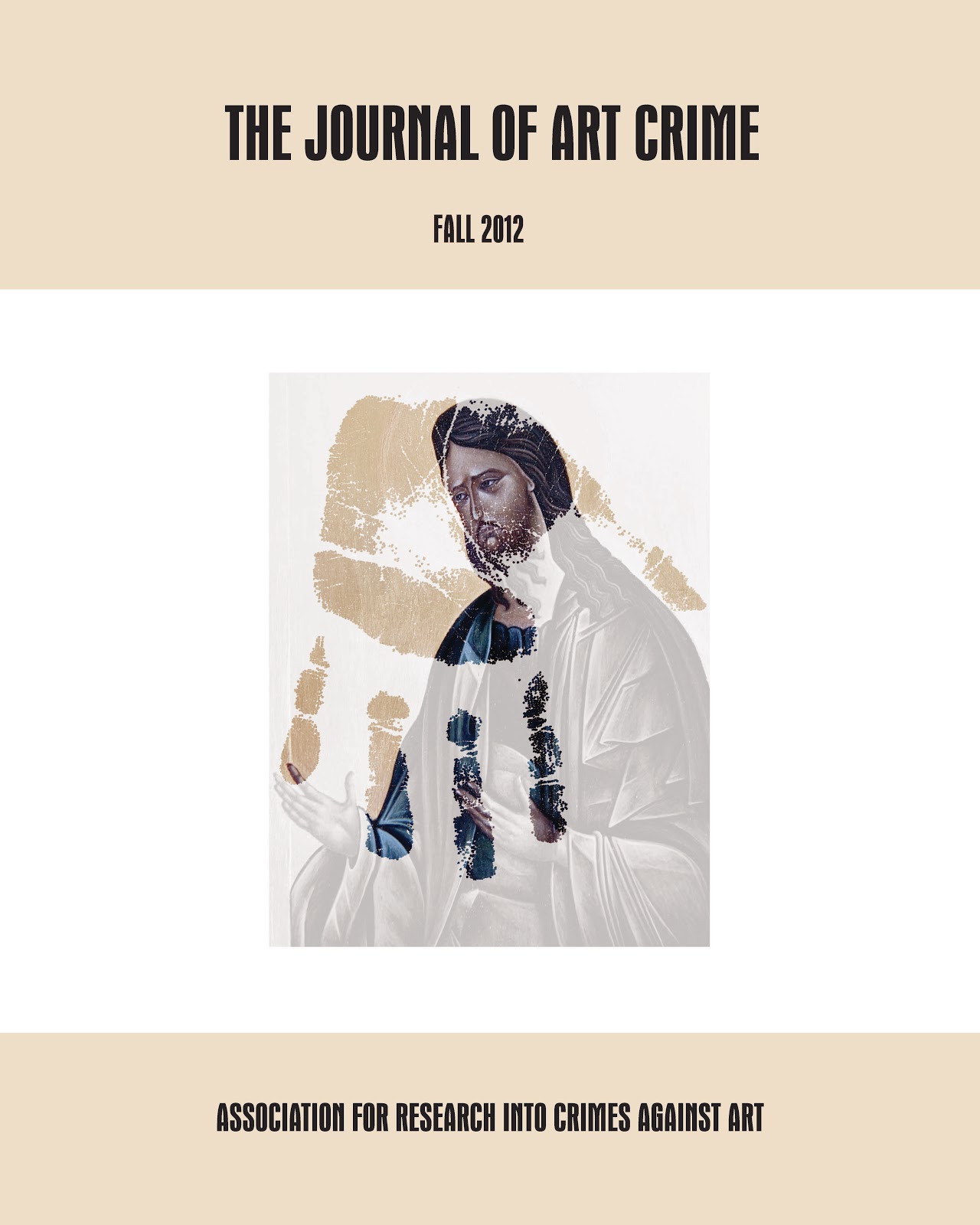
The Journal of Art Crime, Issue 8: Fall 2012

Posted on 10:09 by Unknown
The Journal of Art Crime is edited by Noah Charney and published by ARCA Publications twice a year. The electronic version of the journal is available through a subscription. The eighth issue of The Journal of Art Crime for Fall 2012 includes academic articles, regular columns, editorial essays, and reviews in addition to a "Q&A with Joshua Knelman" by Noah Charney, a Summary of Papers Presented at the 2012 ARCA Conference on the Study of Art Crime and Cultural Heritage Protection, and a list of the 2012 ARCA Awards.

Academic articles: John Kerr on "The Role of the Police in the Co-production of Art Security in London"; Ruth Judson and Richard Porter on "Estimating the Volume of Counterfeit U. S. Currency in Circulation Worldwide: Data and Extrapolation"; Asif Efrat on "Getting Governments to Cooperate against Looting: Insights from the American and British Experience"; Johanna Devlin on "Repatriation via the Art Market: A New Type of Recovery, New Trends Coming from China"; Penelope Jackson on "Planning Revenge: Art Crime and Charles Frederick Goldie"; and Dr. W. (Bill) Wei on "Fingerprinting Objects for the Control of Illegal Trafficking".

Regular Columns: in Context Matters, David Gill writes on "Fragmented Pots, Attributions and the Role of the Academic" and in Lessons from the History of Art Crime, Noah Charney writes on "Counterfeit Money".

Editorial Essays: John Daab on "The Lord Byron Forged Letter: Where's the Questioned Document Analysis (QDE)?"; Aaron Haines on "The Hattusa Sphinx and Turkish Antiquities Repatriation Efforts"; and Mario Buhagiar on "The Sword in the Museum: On Whether La Vallette's Sword and Dagger, Currently Housed in the Louvre, Should be Returned to Malta".
  
Catherine Schofield Sezgin reviews Andrew Shea's documentary film "Portrait of Wally"; Edmund de Waal's book "The Hare with the Amber Eyes: A Hidden Inheritance"; and Anne-Marie O'Connor's book, "The Lady in Gold: Extraordinary Tale of the Klimt Paintings".

In October we'll run subsequent posts on the blog with more information about each submission.
Read More
Posted in Fall 2012, summary, the Journal of Art Crime | No comments
Older Posts Home
Subscribe to: Posts (Atom)

Popular Posts

  • What Happened When Myles J. Connor, Jr. Spoke at the Milton Art Center in MA
    Myles J. Connor, Jr. & columnist Suzette Martinez Standring By Suzette Martinez Standring (suzmar@comcast.net) The flak and hubbub have ...
  • Documentarian Brent Huffman Warns of Dangerous Precedent Being Set in Afghanistan if Mes Aynak is destroyed in ordered to mine copper
    Brent Huffman filming one of the temples set for destruction (Frank Petrella)  by Catherine Sezgin, ARCA Blog Editor Documentary filmmaker B...
  • The Buddhas of Mes Aynak: Kickstart Funds Used to Purchase Computers and Cameras for Afghan Archaeology Office in Kabul
    New computer at Afghan Archaeology Office in Kabul  (Photo via The Buddhas of Aynak on Facebook) Documentarian Brent E. Huffman raised $35,2...
  • Marc Balcells Introduces Christos Tsirogiannis in the Fall 2013 issue of The Journal of Art Crime
    Associate Editor Marc Balcells introduces Christos Tsirogiannis   in an article which begins: I would like to introduce you my colleague at ...
  • Postcard from Istanbul Archaeological Museum: Ancient War booty from Mari (modern Tell Hariri, Syria) to Babylon in the Neo-Babylonian Period
    Puzur-Ishtar, governor of Mari by Catherine Sezgin, ARCA Blog ISTANBUL - Here's an example of ancient 'war booty' on display at ...
  • Janet Ulph's and Ian Smith's "The Illicit Trade in Art and Antiquities" reviewed by Marc Balcells (The Journal of Art Crime, Spring 2013)
    Marc Balcells reviews The Illicit Trade in Art and Antiquities  (Hart Publishing 2012) by Janet Ulph and Ian Smith in the Spring 2013 issue ...
  • Novi Sad City Museum welcomes home "The old man with the fur cap" -- but did Serbian police recover a Rembrandt painting?
    The Novi Sad City Museum welcomes home "The old man with the fur cap" This week did Serbian police recover a painting by Rembrandt...
  • Kunsthal Rotterdam Art Heist: Looking at the Paintings Stolen from the Triton Foundation (Provenance Information Added)
    Lucian Freud, Woman with Eyes Closed by Catherine Sezgin, ARCA Blog Editor The seven paintings stolen from the Kunsthal Rotterdam on October...
  • Theft Anniversary: Two years ago five paintings stolen from Museé d'art moderne de la ville de Paris
    Braque's beautiful Olive Tree Near Estaque  on display in the museum in January 2009/Photo by C. Sezgin Detail from Braque's paintin...
  • The "Other" Dutch Paintings from the Mauritshuis Traveling with Girl with a Pearl Earring from San Francisco to Atlanta to New York City
    Rembrandt, Self-Portrait Germanisches National  Museum by Catherine Schofield Sezgin, ARCA Blog Editor-in-Chief Thirty-four 17th century Dut...

Categories

  • "toxic" antiquities
  • 1911
  • 1954 Convention
  • 1970 Convention
  • 1970 UNESCO Convention
  • 1971 theft
  • 19th century
  • 2012
  • 2012 ARCA Award nominations
  • 2013
  • 2013 ARCA Annual Art And Heritage Conference
  • 2013 ARCA Award Winners
  • A.M.C. Knutsson
  • Adam and Eve
  • Adam Worth
  • Adele Bloch-Bauer
  • advisory panels
  • Afgan Archaeology Office
  • Afghanistan
  • Africa
  • After the Bath
  • Agrigento Ephebe
  • Alain Dumouchel
  • Alain Lacoursière
  • Alceo Dossena
  • Alfred Flechtheim
  • Altman
  • Ambroise Vollard
  • Amelia
  • American Greed
  • American Institute of Roman Culture
  • Amsterdam
  • Anders Burius
  • Andrea Meldolla
  • Andrew Higgins
  • Andy Warhol
  • Ann Shaftel
  • Anne-Marie O'Connor
  • annual conference
  • Anthony Amore
  • antiquities
  • antiquities looting
  • antiquities recovered
  • Antiquities Trade
  • Antonio Diziani
  • appeal
  • Apulian Gnathia
  • ARCA
  • ARCA 2011
  • ARCA 2012
  • ARCA 2012 masters
  • ARCA 2013
  • ARCA 2013 Conference
  • ARCA alum
  • ARCA Annual Conference
  • ARCA Art Crime Scholarship
  • ARCA Awards
  • ARCA Board of Trustees
  • ARCA CEO
  • ARCA Trustee
  • ARCH
  • archaeological artifacts
  • archaeological sites
  • Archaeology
  • Archeology
  • archives
  • armed conflict
  • armed robbery
  • Armenia
  • arson
  • art
  • Art & Business
  • Art Alert
  • Art and Heritage Law
  • Art and Law Policy
  • art and organized crime
  • art auctions
  • art authentication
  • art collecting
  • art conservation
  • Art Cops
  • art crime
  • art crime conference
  • art crime expert
  • art crime in war
  • art crime lecture
  • art crime statistics
  • art damage
  • art dealers
  • art destruction
  • art destuction
  • art expert
  • art forgery
  • art fraud
  • Art Guard
  • art heist
  • art historians
  • Art history
  • art hostage
  • art insurance
  • art law
  • Art Law and Policy
  • Art Loss Register
  • art policing
  • Art Policing and Recovery Award
  • art restitution
  • art restorer
  • art security
  • art theft
  • art theft anniversary
  • art theft arrests
  • art theft in film
  • art theft prosecution
  • art thief
  • art thieves
  • art trade
  • Artemisia Gentileschi
  • Arthur Brand
  • Arthur Tompkins
  • artifacts
  • ARTINFO
  • artists
  • ARTnews
  • Asia
  • Asian Studies
  • askos
  • Assyrian
  • astrolabe
  • Athens
  • Athlete of Fano
  • Auckland Art Gallery
  • auction house thefts
  • auctions
  • Augsburg
  • Augsburg prosecutor
  • Australia
  • Austria
  • authenticity
  • autographic arts
  • Aviva Briefel
  • Award for Art Protection and Security
  • Axum Obelisk
  • Azerbaijan
  • Babylon
  • Baltimore Art Museum
  • Banknotes
  • Banksy
  • Bar Leonardi
  • Battle of Anghiari
  • BBC
  • Becchina
  • Belgium
  • Beltracchi
  • Benin
  • Bernard Ternus
  • Bhutan
  • bicycling thieves
  • Bill Anderson
  • Bill Martin
  • Bill Reid
  • Bill Wei
  • Biltmore House
  • blackmail
  • Blanca Niño Norton
  • Bob Combs
  • Boijmans
  • Bolivia
  • Bonnie Czegledi
  • book review
  • Book Soup
  • book theft
  • books
  • Bosnia
  • Boston Globe
  • Boston MFA
  • Braque
  • Brent Huffman
  • Brighton Knockers
  • Britain
  • british museum
  • Broken Windows
  • Brueghel
  • Bucharest
  • Buddhas of Bamiyan
  • Buddhism
  • Bührle
  • burglary
  • Cairo
  • Calabria
  • Caledonian Boar Hunt
  • California
  • California law
  • Call for Papers
  • Cambodian art
  • Campania
  • Canada
  • Capitoline Museum
  • Carabinieri
  • Carabinieri Art Squad
  • Carabinieri Tutela Patrimonio Culturale
  • Caravaggio
  • Castel Sant'Angelo
  • Castellani
  • Catherine Sezgin
  • Catherine Whitney
  • Caveat Emptor
  • Cellini's Saliera
  • certificates of authenticity
  • Cezanne
  • Chappell
  • CHAPS conference
  • Charles A. Loeser
  • Charles Frederick Goldie
  • Charley Hill
  • Chasing Aphrodite
  • China
  • Chinese antiques
  • chris marinello
  • Christie's
  • Christopher Marinello
  • Christos Tsirogiannis
  • Church
  • city bankruptcy
  • civil forfeiture
  • Claude Picasso
  • Cleveland Apollo
  • Colgate University
  • collateral damage
  • collecting history
  • collections online
  • combat
  • Conference of Protection of Cultural Property in Asia
  • conferences
  • connoisseur
  • connoisseurship
  • conservation
  • Context Matters
  • convictions
  • copies
  • Cordoba
  • Cornelius Gurlitt
  • Corot
  • Corsica
  • Counterfeit Art
  • Counterfeit Money
  • counterfeiters
  • counterfeiting
  • Courbet
  • Courthouse News Service
  • credit fraud
  • criminal investigation
  • Criminals
  • criminology
  • Crispin Corrado
  • Croatia
  • cross-stones
  • crowdsourcing
  • cultural heritage
  • cultural intelligence
  • cultural landscapes
  • Cultural Plunder Database
  • cultural property
  • cultural property crimes
  • Cultural Property Panel
  • Cultural Property Protection
  • cultural property returned
  • Cultural protection
  • cultural repatriation
  • cultural restoration
  • cultural security
  • Curator of Provenance
  • customs
  • Dallas Museum of Art
  • Dan Brown
  • Daniel Silva
  • Danny Boyle
  • Daubert
  • Daumier Register
  • david gill
  • David Turner
  • De Spiegel
  • deaccession
  • deadbolt
  • Degas
  • DePaul
  • Derek Fincham
  • destroying stolen art
  • destruction
  • Detroit Institute of Arts
  • Deutsche Welle
  • Dick Drent
  • Dick Ellis
  • Diego Rivera
  • dinosaurs
  • DIOCT
  • Diplomacy
  • Dirk Hannema
  • disaster relief
  • disputed art
  • documentary
  • Don Hrycyk
  • Donn Zaretsky
  • Donna Tartt
  • Dorit Straus
  • Dulwich Picture Gallery
  • Duncan Chappell
  • Dutch
  • Dutch Art Crime Team
  • Dutch Police
  • Easter
  • economy
  • Edinburgh
  • Edirne
  • Edmund de Waal
  • Eduardo de Valfierno
  • Education
  • Edvard Munch
  • Edward Forbes Smiley
  • Egon Schiele
  • Egypt
  • Eleanor and Anthony Vallombroso Award for Art Crime Scholarship
  • Elizabeth Royer
  • Elmyr de Hory
  • Enez
  • England
  • English law
  • Eric Hebborn
  • Erich Schlomovic
  • erik nemeth
  • Ernst Schöeller
  • Ernst Schöller
  • ERR
  • estimation
  • Ethiopia
  • Euphronios krater
  • European Union
  • evidence
  • executive director
  • exhibit
  • expert
  • expertise
  • Fabio Isman
  • fake
  • fakes
  • fakes and forgeries
  • Fall 2011
  • Fall 2012
  • Fall 2013
  • false insurance claim
  • Farrah Fawcett
  • FBI
  • FBI Art Crime Squad
  • federal rules of evidence
  • fingerprint
  • fire
  • fire alarms
  • flipper method
  • flipper theory
  • Florida
  • FOCUS
  • Foreign Cultural Exchange Jrisdictional
  • forensics
  • forged letters
  • forger
  • forger.
  • forgeries
  • forgery
  • Forum d'Avignon
  • Foundation E. G. Bürhle
  • Four Horses
  • French National Police
  • Fresch Palais
  • fundraising
  • Gabriel Allon
  • Gainsborough
  • galleries
  • Gardner Heist
  • Gavlebocken
  • gentleman thief
  • George Abungu
  • Georges Abungu
  • German forgers
  • Germanicus
  • Germany
  • Getty Museum
  • Getty Research Portal
  • Getty Villa
  • giacomo medici
  • Gianni Alemanno
  • Giles Waterfield
  • Giordano
  • Giorgio Vasari
  • Giovanni Bellini
  • Girl with a Pearl Earring
  • Giulio Carpioni
  • Giuseppe Medici
  • Glafira Rosales
  • Global Heritage Fund
  • glossary
  • Goddesses
  • Gold Rush
  • Goldfinch
  • Goya
  • Grand Mosque
  • Greece
  • Greek coins
  • Guatemala
  • Guggenheim
  • Guilia Rocco
  • guilty plea
  • gunpoint
  • Gurlitt art collection
  • Hammurabi
  • Han Van Meegeren
  • handbook
  • Hare with the Amber Eyes
  • HARP
  • Harry Ettlinger
  • Harvard
  • Hattusa Sphinx
  • Hawley
  • Headache Art
  • Helen Mirren
  • Henri Matisse
  • Herculaneum
  • high value art
  • HIldebrand Gurlitt
  • historical documents
  • holiday thefts
  • Holocaust Art Restitution Project
  • Holocaust restitution
  • Holocaust Restitution Project
  • Hong Kong
  • Honoré Daumier
  • Hot Art
  • Hôtel Lambert
  • Howard Spiegler
  • Hufnagel
  • Hugh Eakin
  • Hugo Simon
  • ICE
  • ICOM
  • iconoclasm
  • identification
  • IFAR
  • Il Veronese
  • Ilaria Dagnini Brey
  • Île St Louis
  • illegal actors
  • illegal trafficking
  • illicit antiquities
  • illicit art trade
  • illicit cultural property
  • illicit trafficking
  • Illuminated Manuscripts
  • immunity
  • in the media
  • Incallajta
  • Incan
  • Inferno
  • Insider theft
  • Integrated Risk Management
  • international
  • International Art Crime Conference
  • International Art Crime Tribunal
  • internet
  • Interpol
  • interview
  • Intifada
  • inventory
  • investigation
  • investigation problems
  • Ioana Patran
  • Irish Independent
  • Irish Travellers
  • Isabella Stewart Gardner Museum
  • ISGM
  • Islam
  • Israel
  • Istanbul
  • Istanbul Archaeology Museum
  • Italy
  • J. Paul Getty
  • Jacob Meyer De Haan
  • Jacques Goudstikker
  • James Alex Bond
  • James Cuno
  • James Moore
  • James Tissot
  • James Whitey Bulger
  • Jane A. Levine
  • Japan
  • Jason Felch
  • Jean Jacques Fernier
  • jean-francois talbot
  • Jeffrey Gundlach
  • Jeu de Paume
  • Jewelry
  • Joe Medeiros
  • John Daab
  • john drewe
  • John Kleberg
  • john myatt
  • John Pollini
  • John Singleton Copley
  • Jonathon Keats
  • Joris Kila
  • Joshua Knelman
  • Judge Arthur Tompkins
  • judith harris
  • Jugha
  • Julia Brennan
  • Julian Radcliffe
  • Jungle Scawlers
  • Kabul
  • Kait Murphy
  • Kanchipuram
  • Karl von Habsburg
  • Katie Ogden
  • Ken Perenyi
  • Ken Polk
  • Kenya
  • Khachqar
  • Khalil-bey
  • King Tut
  • Kirsten Hower
  • Klimt
  • Knoedler & Company
  • Krak des Chevaliers
  • Krieghoff
  • Kunsthal Rotterdam
  • Kunsthistorisches Museum
  • L'Origine du Monde
  • LA
  • LA Times
  • La Valette's Sword and Dagger
  • LACMA
  • Lady in Gold
  • LAPD Art Theft Detail
  • largest art theft in Canada
  • Larry Coben
  • Laura Rush
  • Laurie Adams
  • Laurie Rush
  • Laviano
  • lawyer's committee for cultural heritage preservation
  • Lea Bondi Jaray
  • Leila Amineddoleh
  • Leonardo da Vinci
  • Leopold Museum
  • Lessons from the History of Art Crime
  • Levy
  • Lifetime Achievement in Defense of Art
  • Llewelyn Morgan
  • local community
  • London
  • looted antiquities
  • looted art
  • Looted WII Art
  • Looting
  • Looting Matters
  • Lord Byron
  • Los Angeles
  • Lost Art Internet Database
  • Lost Princess
  • louvre
  • Lucas Cranach the Elder
  • Lucian Freud
  • Lucien Freud
  • Lucien Pissaro
  • Ludo Block
  • Lydian kline
  • Lynda Albertson
  • Lynn Nicholas
  • Maeve Sheehan
  • Maijer de Haan
  • Makkah
  • Malawai National Museum
  • Malawi National Museum
  • Mali
  • Malta
  • mana
  • Manders Collection
  • Maori
  • maps and manuscripts
  • marble monument
  • Marc Balcells
  • Marc Gabolde
  • Marc Masurovsky
  • Marcel Duchamp
  • Marconi University
  • Marei von Saher
  • Mari
  • Maria Altmann
  • Marianne Rosenberg
  • Mario Buagiar
  • Mariotto di Nardo
  • Mark Landis
  • market
  • Martin Finkelnberg
  • Martin Kemp
  • Matisse
  • Matthew Bogdanos
  • Mauritshuis
  • Maurizio Seracini
  • Max Libermann
  • Max Stern
  • Maya Widmaier-Picasso
  • Medici
  • Meg Lambert
  • Melanesian wood carvings
  • Melvyn Kohn
  • memoir
  • Mes Aynak
  • messenger bags
  • metal detectors
  • Meyer de Haan
  • Michel van Rijn
  • Michelangelo
  • micro-roughness
  • mineral museum
  • minor modes
  • Mizzi Zimmerman
  • MoMA
  • Mona Lisa
  • Mona Lisa Foundation
  • Monet
  • money
  • money laundering
  • Montreal Museum of Fine Arts
  • Monuments Men
  • Moshe Dayan
  • Moshe Rynecki
  • Mougins Museum
  • movies
  • Munich
  • murals
  • Musee d'Art Moderne de la Ville de Paris
  • Musée d'Orsay
  • Museo Thyssen-Bornemisza
  • museum
  • Museum Catharijneconvent
  • museum funding
  • Museum of Anthropology
  • Museum of Decorative Arts in Bergen
  • Museum of Modern Art in Sweden
  • museum security
  • museum theft
  • Museum thefts
  • Museum van Bommel van Dam
  • museums
  • music
  • Mussolini
  • Myles J. Connor
  • mythology
  • Napoli
  • Narni
  • National Etruscan Museum
  • National Gallery in Prague
  • National Museum of Scotland
  • National Museum of Serbia
  • National Stolen Art File Search
  • Nativity
  • Nazi art
  • Nazi art theft
  • Nazi-era looted art
  • negotiate
  • Neil Brodie
  • Nemetz
  • netsuke
  • new york city
  • New Zealand
  • news media
  • Nice
  • Nicolas Poussin
  • Niels Rutger
  • Noah Charney
  • North America
  • Norton Simon Museum
  • Norway
  • Norwegian Minister of Foreign Affairs
  • Novi Sad City Museum
  • Nuraghic bronze statuettes
  • NYC
  • NYTimes
  • Odyssey Marine
  • Okinawa
  • Olympia
  • Oplontis
  • organized crime
  • Ori Z. Soltes
  • Orpheus mosaic
  • Oskar Kokoschka
  • Oxford
  • Pablo Picasso
  • Padma Kaimal
  • painting analysis
  • Palais Fesch
  • Palermo
  • Palestine
  • Palmyra
  • Paolo Ferri
  • Parioli
  • Paris
  • partage
  • Pasadena
  • Patras
  • Paul Gauguin
  • Paul Hendry
  • Paul Rosenberg
  • Penny Jackson
  • People Not Stones
  • Permanenten Vestlandske Kunstindustrimuseum
  • Peru
  • Peter Paul Rubens
  • Peter Silverman
  • Peter Watson
  • petition
  • photographers
  • Picasso
  • pickpockets
  • Pico Iyer
  • plastic
  • Poland
  • Polaroids
  • police cooperation
  • police seizures
  • political economy
  • Pompeii
  • Port of Rotterdam
  • Porta Romana
  • Portrait of Wally
  • Post Certificate Program
  • preservation
  • press conference
  • Pretoria Art Museum
  • Princeton
  • private insurance
  • private policing
  • profilometry
  • prosecution
  • provenance
  • Provenance Research Training Program
  • psychology of forgers
  • public awareness
  • QDE process
  • Quebec
  • Quebec Art Crime team
  • Questioned Document Examination
  • Rachel Ruysch
  • Rajlich
  • Ralph Frammolino
  • Rape of Europa
  • rare maps
  • Rathkeal Rovers
  • RCMP
  • Rebecca Dreyfus
  • recovered cultural patrimony
  • Recoveries
  • recovery
  • religious art
  • Rembrandt
  • Renoir
  • renovation
  • repatriation
  • research
  • residential
  • restitution
  • Restitution Court
  • restoration
  • Reuters
  • reward
  • RFID
  • Rhino thefts
  • Richard Abath
  • Richard Ellis
  • Rick Abath
  • Rick St. Hilaire
  • Rijksmuseum
  • robbery
  • Robert Edsel
  • Robert Gentile
  • Robert Mang
  • Robert Volpe
  • Robert Wittman
  • Robin Symes
  • Rodolfo Siviero
  • Roman bronzes
  • Romania
  • Romanian Police
  • Rome
  • Rosa da Tivoli
  • Rossetti
  • roughness
  • Rudolf Leopold
  • Ruoppolo
  • Ruth Godthelp
  • S. 2212
  • Sackler Galleries of Art
  • sale of stolen paintings
  • Salvator Rosa
  • Sandy Nairne
  • Santa Monica
  • Sarajevo Haggadah
  • Sardinia
  • Sassari
  • Saving Italy
  • scandals
  • Schinousa archive
  • Scholarship - Books
  • Schoonhoven
  • Schubert at the Piano
  • Schwabing Art Fund
  • Schwabinger Kunstfund
  • Scotland
  • Scotland Yard
  • sculptor
  • Sea of Galilee
  • security
  • Security guards
  • security options
  • security specialist
  • sentencing
  • Serbia
  • Sharon Cohen Levin
  • shipwrecks
  • Sicilian Mafia
  • Sicily
  • Sisley
  • Skokloster Castle
  • smash and grab
  • smuggling
  • snuffboxes
  • sociology of crime
  • Sotheby's Auction
  • South Africa
  • South India
  • Spain
  • speaker
  • Spring 2013
  • spring/summer 2012
  • St. Patrick's Day
  • stamp theft
  • Stealing Rembrandts
  • Stefano Alessandrini
  • stele
  • Stockholm
  • stolen antiquities
  • stolen art
  • Stolen Art Bulletins
  • stolen art database
  • Stolen Art Recovered
  • Stolen Artwork Restitution Act
  • Stolen the film
  • Stonehill Art Crime Symposium
  • Stonehill college
  • street art
  • strikes
  • Stroganov Collection
  • stuart george
  • study of art crime
  • Stuttgart Fine Art and Antiquities Squad
  • summary
  • Sureté du Québec
  • surveillance video
  • Sussex Police Art and Antiques Squad
  • Sustainable Preservation Initiative
  • Sweden
  • Swedish Royal Library
  • Switzerland
  • Sydney
  • Symes
  • Symposium
  • Syria
  • ta moko
  • Takeaway Rembrandt
  • Taliban
  • Tauranga Art Gallery
  • tax fraud
  • Teddy Kollek
  • television
  • Tess Davis
  • textiles
  • Thailand
  • The Caravaggio Conspiracy
  • The Empty Frame
  • the Getty
  • the Journal of Art Crime
  • The Journal on Art Crime
  • the medici conspiracy
  • the met
  • the missing piece
  • The Monuments Men
  • The Netherlands
  • The New York Times
  • The New Yorker
  • The Palermo Nativity
  • The Rape of Europa
  • The Scream
  • The Venus Fixers
  • theft
  • Thierry Lenain
  • Thomas Kline
  • Timbuktu
  • Tom Flynn
  • Tom Keating
  • Tom Mashberg
  • Ton Cremers
  • TPC
  • Trance
  • Transnational crime
  • travel
  • treasure
  • Triamphal Quadriga
  • trickster
  • Triton Collection
  • Turkey
  • Typology of interfaces
  • U. S. Fish and Wildlife Service
  • U.S. News
  • UBC
  • Uffizi Gallery
  • UK
  • Ulrich Boser
  • Umbrians
  • undercover agent
  • UNESCO
  • United States
  • Universal Museums
  • University of Pennsylvania
  • Unlisted Conference
  • unsolved art theft
  • urgency
  • US law
  • V&A Symposium
  • Valerie Higgins
  • Van Gogh
  • Van Gogh Museum
  • Vancouver
  • vandalism
  • Veletrzni Palace
  • venice
  • Vermeer
  • vernon rapley
  • Victoria and Albert Museum
  • Victoria Reed
  • Victorian crime
  • Vienna
  • Viking artifacts
  • Villa Giulia
  • Vincent van Gogh
  • Vincenzo Peruggia
  • violin recovery
  • violin theft
  • Virginia Curry
  • Virginia Museum of Arts
  • Wales
  • Wall Street Journal
  • war booty
  • warrant
  • wartime losses
  • Washington DC
  • West Africa
  • Whicher
  • William Kingsland
  • wine fraud
  • Witches in Air
  • Worcester Art Museum
  • workshop
  • world heritage sites
  • World Press Photo Exhibit
  • World War II
  • writer in residence
  • Yale University
  • Zurich

Blog Archive

  • ▼  2013 (295)
    • ▼  December (29)
      • Was the repatriation of a footless 10th century st...
      • Fabio Isman reports on scholar Augusto Gentili's i...
      • Link to Radio New Zealand's Interview with Penny J...
      • "Selling Russia's Treasures" writes about the coll...
      • A flaming Swedish Christmas tradition – the annual...
      • Christos Tsirogiannis Interviews Marc Balcells in ...
      • Marc Balcells Introduces Christos Tsirogiannis in ...
      • Ilaria Dagnini Brey's "The Venus Fixers" and Rober...
      • Editorial Essay: Suzette Scotti writes about "Do U...
      • Christos Tsirogiannis on "From Apulia to Virginia:...
      • Derek Fincham's column "The Empty Frame" on "Detro...
      • Columnist David Gill on "The Cleveland Apollo Goes...
      • Noah Charney in "Lessons from the History of Art C...
      • Marine Fidanyan on "Destruction of Jugha Necropoli...
      • Brent E. Huffman Presenting Special Advance Screen...
      • Christie's New York Auction of "Antiquities" withd...
      • Duryodhana statue from Prasat Chen, Cambodia: "Vol...
      • Sotheby's sells Symes marble matched by Dr. Christ...
      • Felicity Strong on "The Mythology of the Art Forge...
      • Bojan Dobovšek and Boštjan Slak on "Criminal Ins...
      • Update on the search for the oeuvre of Polish arti...
      • "Victorian Art Theft in England: Early Cases and S...
      • Gurlitt Art Collection: The Economist publishes le...
      • "The Crime That Pays? The Canadian Print Media's C...
      • Isabella Stewart Gardner Theft: Boston's WGBH News...
      • DIA evaluation of $2 billion includes only 'works ...
      • The Fall 2013 issue of The Journal of Art Crime No...
      • Persian chalice authentic or fake? Dutch Art Inves...
      • ARCA Associates participating in International Con...
    • ►  November (41)
    • ►  October (17)
    • ►  September (13)
    • ►  August (47)
    • ►  July (28)
    • ►  June (16)
    • ►  May (14)
    • ►  April (21)
    • ►  March (35)
    • ►  February (19)
    • ►  January (15)
  • ►  2012 (205)
    • ►  December (8)
    • ►  November (20)
    • ►  October (36)
    • ►  September (12)
    • ►  August (19)
    • ►  July (26)
    • ►  June (19)
    • ►  May (27)
    • ►  April (21)
    • ►  March (17)
Powered by Blogger.

About Me

Unknown
View my complete profile